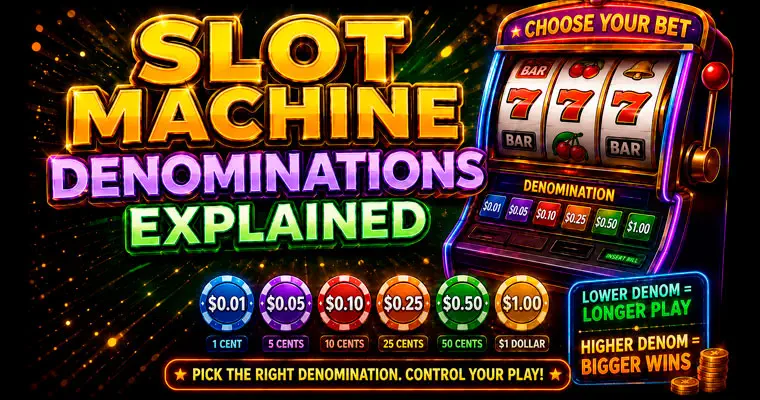
Slot denomination is the monetary value assigned to one credit — for example 1¢, 5¢, 25¢, $1 or $5. It is not automatically the same thing as the total amount wagered per spin. A 1¢ machine can require or allow dozens or hundreds of credits per spin, while a $1 machine can use only a few credits. On a multi-denomination machine, changing denomination can also load a different paytable, line structure, jackpot condition or theoretical return.
Short answer: denomination matters only through the rules attached to that denomination. If two denominations use the same probability model and proportional paytable, choosing the higher denomination does not make the RNG more generous — it mainly changes the money at risk. But regulated multi-denomination machines can contain different paytables and different theoretical hold percentages by denomination, so the exact game rules must be checked rather than assuming “penny” and “dollar” are only display labels.
How Slot Machine Denominations Work
In a credit-based slot, denomination is the cash value of one credit. If the denomination is $0.01, one displayed credit is worth one cent. If the denomination is $1, one credit is worth one dollar. For the long-run return metric, see What Is RTP in Slots?.
If a 1¢ game wagers 88 credits, the total stake is $0.88. If a $1 game wagers three credits, the stake is $3. The denomination tells you what each credit is worth; the credit count tells you how many of those units are being risked.
Modern machines can hide part of this arithmetic by showing only a direct cash bet such as $0.80, $1.20 or $5.00. Others expose coin value, bet multiplier, credits, paylines or several controls at once. The final total bet is the number that determines the amount removed from the balance for that spin.
Denomination, Bet Size and Credits Are Different
| Term | What it means | Example | Can it change game rules? |
|---|---|---|---|
| Denomination | Cash value of one credit | 1¢, 25¢, $1 | Yes, on some multi-denomination games |
| Credits | Number of denomination units wagered or paid | 88 credits | Sometimes, if coin count unlocks a paytable or feature |
| Total bet | Actual money wagered on the spin | 1¢ × 88 = $0.88 | Can affect eligibility or modes if rules say so |
| Bet multiplier / level | Game-specific control that scales or changes the wager | 1x, 2x, 5x | Possibly |
| RTP | Theoretical long-run return of the active paytable/configuration | 96% | It is a property of the selected mathematical model, not merely the cash stake |
The common mistake is to collapse all five into “bet size.” A player can increase total bet without changing denomination, change denomination while keeping a similar total bet, or select another denomination that loads a different approved paytable.
Why a Penny Slot Does Not Mean a 1¢ Spin
“Penny slot” traditionally refers to a one-cent credit denomination. It does not guarantee that one cent is a valid complete wager.
For example, a machine could use a 1¢ denomination and an 80-credit minimum. The minimum total bet would then be $0.80. Another penny machine could use 50 credits, 88 credits or another game-specific amount. The displayed denomination remains one cent because each credit is worth one cent.
IGT's current customer par-sheet search results illustrate why the credit structure must be read rather than guessed. For Rising Rockets Empress, IGT documents different line counts and credit requirements across denomination groups: 50 lines for the two lowest denominations and 25 lines for the two highest, with different minimum and maximum credit bets. That is a real manufacturer example where denomination is tied to more than the value printed on one credit.
Denomination and RTP
Can Changing Denomination Change RTP?
Yes, it can — but it does not have to.
Nevada's slot-control rules explicitly recognize multi-denomination machines where different slot machine Slot machine slot machine denominations can have different theoretical hold percentages. The state's Internal Control Procedures require coin-in to be recorded by denomination when a paytable has a different theoretical hold percentage for each denomination. The regulator also requires manufacturer theoretical-hold worksheets for each active paytable.
This establishes an important point: different RTP by denomination is a legitimate, regulated product design. It does not establish that every multi-denomination game uses different RTP values.
Nevada's online slot-metering standards go further: systems must maintain paytable coin-in and theoretical payback information for multi-game and multi-denomination machines, and calculate theoretical hold based on the active paytables and their coin-in contribution. That regulatory accounting would be unnecessary if denomination could never correspond to a different mathematical configuration.
Does a Higher Denomination Always Have Better RTP?
No. higher slot machine denominations can be associated with higher-return products in aggregate, but there is no universal monotonic rule that every step from 1¢ → 5¢ → 25¢ → $1 → $5 must increase RTP.
The latest statewide Nevada report available on August 13, 2026 covers the twelve months ending June 2026. It reports actual casino win percent by denomination — casino win divided by total dollars played — not theoretical RTP for one machine.
| Nevada slot category | 12-month actual casino win % | Implied aggregate player return* |
|---|---|---|
| 1 Cent | 8.87% | 91.13% |
| 5 Cent | 6.11% | 93.89% |
| 25 Cent | 7.53% | 92.47% |
| $1 | 6.30% | 93.70% |
| $5 | 4.53% | 95.47% |
| $25 | 6.86% | 93.14% |
| $100 | 4.94% | 95.06% |
| Multi Denomination | 6.96% | 93.04% |
*Calculated as 100% minus the regulator's reported actual win percent. This is an aggregate historical result, not theoretical RTP and not a forecast.
The pattern is enough to disprove a simplistic ladder. The $5 category had a lower casino win percentage than penny slots, but 25¢ performed worse than 5¢, and $25 performed worse than both $5 and $100. Different machines, game mixes, progressive contributions, betting patterns and amounts of coin-in sit inside each category.
You therefore cannot look at this table and conclude that changing one machine from 1¢ to $1 will increase its RTP by a known amount. The report describes different populations of wagers, not a controlled experiment on one game.
Actual Return Is Not the Same as RTP
Nevada defines slot “Win Percent” in the monthly revenue report as reported casino win divided by the total dollar amount played. It is an actual historical result.
RTP is theoretical. If a game is configured at 96% RTP, that describes its mathematical expectation over the model's long-run distribution. A casino, denomination category or individual machine can finish a month or year above or below that theoretical level because actual outcomes vary.
Those formulas look similar but describe different things. Do not label an observed statewide return as the RTP of penny slots.
Can One Multi-Denomination Machine Use Different Paytables?
Yes. Nevada's controls explicitly discuss multi-game and multi-denomination machines with multiple paytables, including cases where paytables have different theoretical payback percentages by denomination.
Manufacturer documentation shows the practical side. IGT's customer par sheet for Rising Rockets Empress groups denominations with different line counts and credit-bet structures: the two lower denominations use 50 lines while the two higher denominations use 25 lines. IGT's Mystery of the Lamp par sheet similarly documents different line counts across lower, middle and higher denomination groups.
That means switching denomination can potentially change several things at once:
- credit value;
- minimum and maximum total bet;
- number of paylines or another bet structure;
- paytable;
- progressive reset or contribution rules;
- jackpot eligibility;
- theoretical return.
Which of those actually changes is game-specific.
Can the Casino Change RTP Just Because You Press 1¢ or $1?
The machine can offer approved configurations associated with different denominations if that product was designed and approved that way. That is different from a casino secretly deciding to reward a player for selecting $1 instead of 1¢.
Nevada's technical standards require theoretical payback percentages to be tied to approved game/paytable configurations, and internal controls require changes in theoretical hold to be tracked in slot-analysis records. The operator cannot treat theoretical return as an undisclosed per-player slider.
For the wider distinction between configuration control and individual spin outcomes, see Can Casinos Control Slot Machines?.
Penny vs Dollar: What Changes
| Question | Penny denomination | Dollar denomination | Universal rule? |
|---|---|---|---|
| Value of one credit | $0.01 | $1.00 | Yes, by definition |
| Minimum total spin | Can be far above $0.01 | Can be $1 or several dollars | No |
| RTP | Game/paytable-specific | Game/paytable-specific | No |
| Volatility | Game-specific | Game-specific | No |
| Paylines / Ways | Can vary by game/denom | Can vary by game/denom | No |
| Jackpot eligibility | May have denomination-specific rules | May have denomination-specific rules | No |
| Cash exposure per credit | Lower | 100× a 1¢ credit | Yes, before considering number of credits |
When comparing slot machine denominations, the useful comparison is not “penny vs dollar” in isolation. It is this penny paytable at this total bet versus this dollar paytable at this total bet. Win frequency is a separate property; see Slot Hit Frequency Explained. For version-specific RTP differences, see Do Different Casinos Have Different RTP?.
Does Higher Denomination Mean Higher Volatility?
Across slot machine denominations, volatility still depends on the game's prize distribution rather than the coin value alone. Not by definition. Volatility describes the distribution of payouts: how often wins occur and how concentrated return is in larger outcomes. Denomination changes the money represented by each credit.
If the exact same probability model is simply scaled from 1¢ to $1 credits, the volatility in multiplier/credit terms can remain unchanged while cash swings become 100 times larger per credit. A $500 swing feels more volatile than a $5 swing, but that is monetary exposure, not necessarily a different probability distribution.
If changing denomination loads a different paytable, then volatility can change because the game configuration changed. Check the rules rather than inferring volatility from the denomination button. See What Does Volatility Mean in Slots?.
Does Higher Denomination Improve Hit Frequency?
Again, only if the active game rules differ. Hit frequency is the probability that a spin produces whatever the game counts as a hit. A larger credit value does not, by itself, create more winning symbol combinations.
A multi-denomination game could pair different denominations with different paytables, making hit frequency different in practice. But the denomination label alone does not tell you that. If hit frequency matters, use the published game data where available. See How Often Do Slots Pay Out?.
Denomination and Max Bet Are Different Controls
Changing denomination is not the same as pressing Bet Max.
Suppose a machine offers:
- 1¢ denomination, 50–500 credits; and
- 10¢ denomination, 10–100 credits.
The largest 1¢ wager would be $5. The largest 10¢ wager would be $10. “Max bet” refers to the highest permitted credit/bet setting within the selected configuration; “denomination” describes what each credit is worth.
Some classic machines use a non-linear max-coin paytable, and some jackpots require a qualifying denomination or stake. That question belongs on Should You Play Max Bet on Slots? and Do You Need Max Bet to Win a Jackpot?.
Can Jackpot Eligibility Change by Denomination?
Yes. A progressive or fixed jackpot can be tied to a qualifying denomination, minimum wager, maximum coins, side bet or another published condition.
The critical word is published. Do not assume that choosing $1 makes every jackpot more likely than choosing 1¢. Check whether the jackpot rules say:
- eligible denominations;
- minimum qualifying wager;
- maximum credits required;
- bet-weighted probability;
- different reset values by denomination;
- a separate jackpot contribution.
Nevada's controls also recognize progressive contributions as part of theoretical hold accounting, which is another reason one denominator/paytable configuration can differ from another.
Multi-Denomination and Online Slots
What Is a Multi-Denomination Slot?
A multi-denomination slot lets the player select from more than one credit value on the same gaming device. IGT currently advertises player-selectable multi-denomination setups on products such as Magic Treasures Gold, while Nevada maintains a separate “Multi Denomination” category in its statewide slot revenue report.
Multi-denomination does not mean every denomination is just a cosmetic rescaling. The regulatory system tracks coin-in and theoretical payback by paytable and, when needed, by denomination. Always re-check the paytable after changing denomination.
Online Slots: Where Did the Denomination Button Go?
In online slots, slot machine denominations may be hidden behind a direct cash-bet control rather than a visible 1¢ or $1 selector. Others still use coin value, bet level or credits internally.
If an online game shows only “Bet $1.00,” denomination may be irrelevant to the interface. The important questions become:
- What is the active total stake?
- Does changing the stake load another mode or paytable?
- Does the RTP field change?
- Does jackpot eligibility change?
- Does a feature bet or ante become active?
This is why the broader principle works online too: follow the rules attached to the active configuration, not terminology inherited from mechanical coin slots.
Cost, High-Limit Play and Selection
Does a Higher Denomination Cost More in the Long Run?
If RTP is the same and the total wager per spin is higher, expected loss in money is higher simply because more money is being put through the same house edge.
At 96% RTP:
| Total stake | Theoretical house edge | Expected loss per spin |
|---|---|---|
| $0.50 | 4% | $0.02 |
| $1 | 4% | $0.04 |
| $5 | 4% | $0.20 |
| $25 | 4% | $1.00 |
These are long-run expectations, not predictions of what one spin or session will lose. The calculation also assumes the same 96% configuration. If changing denomination changes RTP, recalculate with the active value.
High-Limit Slots and Higher Denominations
A high-limit room often contains higher-denomination or higher-minimum-bet machines, but “high limit” is a floor-placement and wagering concept, not a mathematical guarantee.
The Nevada aggregate data are often cited to claim that high-limit machines are looser. The latest report does show lower actual win percentages for some higher denominations, especially $5 and $100, but the pattern is not monotonic and the underlying game mix differs. That evidence can support the statement “higher-denomination categories sometimes show lower observed casino hold”. It cannot support “every high-limit version has higher RTP.”
Can You Identify RTP From the Denomination?
No. The denomination can be a clue that another paytable is active, but you still need the actual RTP disclosure or manufacturer/regulatory documentation.
For an online game, open Help, Rules, Paytable or Game Info. For a land-based machine, inspect the help/paytable screens and any required posted information. If the machine offers several denominations, check again after changing denomination because the rules or paytable can change.
See How to Check a Slot's RTP for the verification workflow.
Slot Machine Denominations: Selection Checklist
- Read the total bet. Do not judge cost from the denomination alone.
- Calculate credits if needed. Denomination × credits should reconcile to the displayed wager in a simple credit model.
- Change denomination and reopen the paytable. Look for changed lines, bet steps, jackpot values or features.
- Check RTP again. Do not assume the percentage remains constant across denominations.
- Check jackpot eligibility. Look for denomination-specific qualifiers.
- Check max-coin rules. A non-linear top award is different from a denomination change.
- Separate cash volatility from mathematical volatility. Higher credit value makes swings larger in dollars even if the probability model is unchanged.
- Set the stake from the budget, not from the idea that a higher denomination is “due” to pay better.
Slot Machine Denominations: Frequently Asked Questions
Slot Machine Denominations: The Bottom Line
Denomination is the value of one credit, not the total cost of a spin and not a quality rating. A penny slot can cost dollars per spin; a dollar slot can use only a few credits; and a multi-denomination machine can load different lines, jackpots or mathematical configurations when the denomination changes.
Higher denominations are not automatically better. Nevada's aggregate statistics show that some higher-denomination categories have lower observed casino hold than penny slots, but the sequence is not monotonic and those data compare different populations of machines and wagers. The only defensible way to compare two denomination settings on one game is to read both active paytables, verify RTP and jackpot rules, then compare the actual total stake.
If denomination does not change the rules and the larger setting only increases the amount wagered, it does not create an edge. It simply puts more money through the same game model.
Want a random game instead of another mechanic to compare? Try SlotRandomizer.