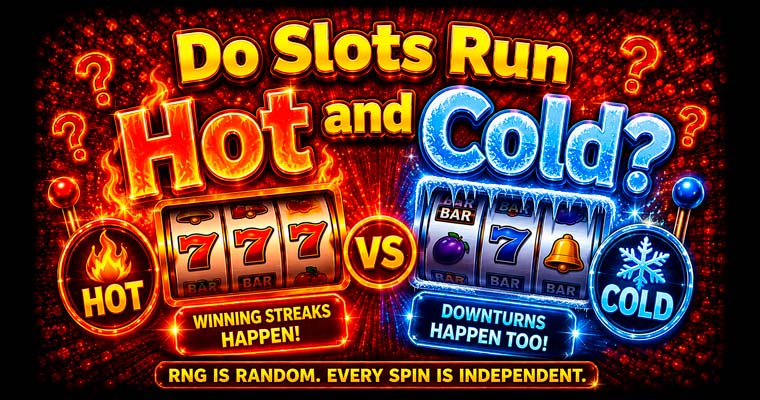
Every player has seen it: a game that pays four times in ten spins, then nothing for a hundred. The streaks are not imaginary — clusters of wins and droughts are normal and increasingly likely in long sequences of independent results. The myth is not that streaks happen; it is that they reveal a state of the machine that will continue into the next spin.
Streaks exist in the record, but they do not reveal an undisclosed hot or cold state. Under UKGC RTS 7 and GLI-19, recent payouts may not be used to adapt hidden probabilities or the game’s theoretical return. A disclosed persistent feature can carry state between spins, but ordinary wins and losses alone do not show that the next result has become more or less likely.
Why Streaks Feel So Real
Streaks are normal products of randomness, not evidence that the probabilities have changed. In 200 fair coin tosses, the chance of seeing at least one run of six heads is about 80%, while the chance of six identical results in a row — heads or tails — is about 96.5%. A slot is not a binary coin-flip model, but the example shows why conspicuous clusters can arise without memory or adaptation. Looking backwards, the record may genuinely contain a hot-looking stretch; that does not turn the description into a forecast. A streak is a description of the past, dressed up as a prediction.
What the Standards Require Instead
Under the online standards cited here, this is not left to interpretation. UKGC RTS 7 requires chance-based outcomes to be acceptably random and specifically prohibits compensated or adaptive game behavior — probabilities may not be changed, automatically or manually, in response to previous play. In other words, the standard names the exact kind of machine the myth imagines, a game that adjusts itself toward or away from payouts, and forbids it, while explicitly allowing disclosed bonus and special rules.
GLI-19 draws the same line from the technical side: monetary outcomes must be determined by approved RNG output, the probability of a bonus may not change based on the history of previous awards, and a game's theoretical return may not be adapted to a player from previous payouts. Randomness may correlate with earlier games only where the rules provide for it. The outcome model behind these requirements is covered in what is RNG in slot machines.
The Real Exceptions: Disclosed Persistent Features
Some games legitimately carry documented progress between plays. A collection meter, saved achievement or persistence mechanic may move closer to a specifically defined threshold as its rules describe. That does not automatically mean the next spin has positive value or that every displayed meter changes the probability of an award. GLI-19 requires persistence features, their thresholds and the method of restoring progress to be explained in the help screens.
The distinction is disclosure and specificity. A real persistent state has a defined rule, documented progress and an identifiable threshold. A claimed "hot phase" inferred only from recent payouts has none of those properties — if it actually changed probabilities because of those payouts, it would be the undisclosed adaptive behavior prohibited by the cited standards. If a game seems to remember something, the first place to check is its help screen, not the last hour of results.
Hot and Cold vs Loose and Tight
The streak myth has a quieter cousin: the idea that some machines are configured to pay less. Configuration is real — the same title can be certified and offered in several RTP versions, as covered in why the same slot can have different RTP. But the deployed configuration is a game property, not a short-term mood produced by recent payouts: it remains governed by the installed rules while that version is offered, and a casino may deploy another approved version — which is why the in-game information should be checked directly. Timing folklore built on top of these ideas — better hours, paying weekdays — is taken apart separately in the best time to play slots.
Streak-chasing selects games by their past; the database selects them by their published figures. One of these is information.
Pick a slot by the data →Frequently Asked Questions
The Bottom Line
The run is in your history, not in the machine. Read the help screen for real, documented state; treat everything else as a record of the past — and choose games by their published figures rather than their last hour.