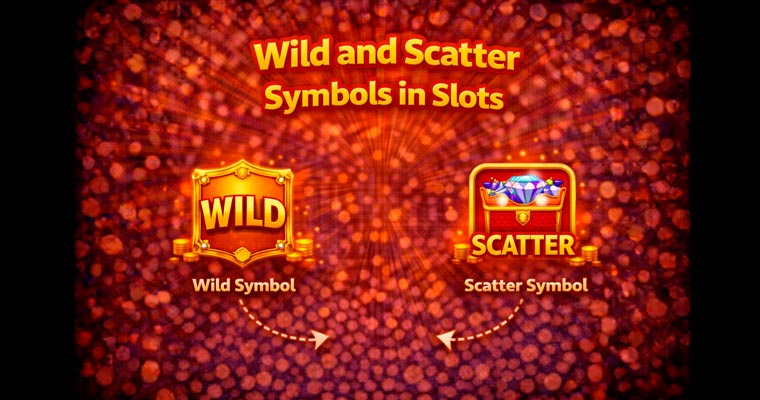
Wild symbols substitute for other symbols to complete winning combinations. Scatter symbols trigger bonus features — usually free spins — regardless of where they land on the reels. These are the two most important special symbols in online slots, and understanding how they work is essential before you play any game. Wilds act like a joker in a card game: they fill in wherever they’re needed. Scatters act like a key: land enough of them anywhere on the screen, and they unlock the main bonus round. This guide explains both in detail, including the different types you’ll encounter and how to check what they do in any specific slot.
Wild Symbols: The Substitute
A wild symbol replaces other regular symbols to help form a winning combination. If you land two matching symbols on a payline and a wild appears in the adjacent position, the wild counts as a third matching symbol — completing what would otherwise be a losing spin.
The critical rule: they stand in for regular paying symbols only. In most slots, wilds cannot replace scatter symbols, bonus symbols, or other special symbols. The info screen specifies what it can and cannot stand in for.
In some games, wilds also carry their own payout value — often as the highest-paying symbol on the paytable. Landing a full line of wilds typically awards the top base-game prize. In other games, wilds have no standalone value and exist purely as substitutes. Whether wilds pay on their own is documented in the rules section — check before assuming a full row of wilds guarantees a big win.
Where wilds can appear also varies. Some slots allow wilds on all reels. Others restrict them to specific reels — commonly reels 2, 3, and 4 on a five-reel slot, keeping them off reels 1 and 5. This isn’t arbitrary: restricting wilds to center reels is a mathematical control mechanism. If wilds could appear on reel 1, small winning combinations would form far more often, forcing the provider to reduce payouts elsewhere (typically in the bonus round) to maintain the target RTP. The paytable or info screen will tell you which reels carry wilds for any given game.
Types of Wild Symbols
Modern slots have evolved the basic wild concept into numerous variants. Each type changes behavior and impact. Here are the most common types you’ll encounter:
Standard Wild — the basic version. It substitutes for other symbols in the position where it lands. No special behavior. Found in virtually every slot that includes wilds.
Expanding Wild — when it lands, it expands to cover the entire reel from top to bottom. Every position on that reel becomes wild, dramatically increasing the number of possible winning combinations. Starburst (NetEnt) is a classic example: expanding wilds on reels 2, 3, and 4 are the main feature.
Sticky Wild — it remains locked in place for one or more subsequent spins. Instead of disappearing after the current spin resolves, it stays on the reels while new symbols spin around it. They are most commonly found during free spins rounds, where they accumulate over multiple spins to build toward larger wins. Dead or Alive 2 (NetEnt) is built around this mechanic.
Stacked Wild — these appear as a vertical stack of wilds on a single reel, occupying two, three, or all positions on that reel simultaneously. When multiple stacks land on adjacent reels, they can create massive multi-line wins. Many Pragmatic Play titles use stacked wilds, including The Dog House.
Walking Wild / Shifting Wild — a symbol that moves across the reels with each subsequent spin, typically shifting one reel to the left (or right) per spin until it falls off the edge of the grid. Each shift triggers a free re-spin. Jack and the Beanstalk (NetEnt) is a well-known example of walking wilds.
Multiplier Wild — it works as a standard substitute and simultaneously applies a multiplier to any win it helps complete. A 2x multiplier wild doubles the payout; a 3x wild triples it. When two multiplier wilds appear in the same winning combination, the interaction varies by provider: in Pragmatic Play and Nolimit City slots, multipliers usually multiply together (2x × 3x = 6x), while in some Play’n Go titles, they add instead (2x + 3x = 5x). Always check the rules screen for the specific math. Nolimit City’s xNudge wilds — which increase their multiplier each time they nudge into view — are a popular variation of this type.
Random Wild / Raining Wild — the game randomly places these icons onto the reels during a spin or between cascading wins. The player doesn’t control where they land. Thunderstruck II (Microgaming) and various Pragmatic Play titles use random wild placement as a base-game feature.
Colossal / Giant Wild — an oversized wild that covers a block of positions, commonly 2×2 or 3×3 symbols. Because it occupies multiple reel positions simultaneously, it can contribute to wins across many paylines at once.
Nudging Wild — when this wild lands partially in view (above or below the visible reel area), it nudges up or down to become fully visible. In some games, each nudge also increases a multiplier attached to the wild.
Mystery Wild — appears as a mystery or unknown symbol first, then reveals itself as a wild (or transforms surrounding symbols into wilds). Mystery wilds add an element of anticipation, since you don’t know their effect until after the spin settles.
Synced Reels / Wild Reel — a mechanic where two or more adjacent reels display identical symbols, or an entire reel fills with wilds. This creates guaranteed matching combinations across the synchronized reels. Common in Big Time Gaming’s Megaways titles and some Yggdrasil games.
Scatter Symbols: The Bonus Trigger
Scatters serve a fundamentally different purpose. While wilds help you win within the base game’s regular mechanics, scatters unlock the bonus features — most commonly the free spins round.
The defining characteristic of a scatter is that it pays or triggers its effect regardless of position. Regular symbols must land on an active payline in a specific sequence (usually left to right) to produce a win. Scatters don’t need to align on any payline. They can land on any reel, in any row, and still count — as long as you hit the minimum number required.
The standard trigger threshold is three scatters on a single spin. Many games award additional benefits for landing more: three scatters might give you 10 free spins, four might give you 15, and five might give you 20 or more. The exact numbers are specified in the rules section.
Scatters also frequently pay out a direct cash prize in addition to triggering the bonus feature — but not always. Some scatters only trigger and pay nothing on their own; others pay a multiplier of your total bet even before the bonus starts. This scatter payout is calculated against your total bet, not your line bet — another distinction from regular symbol payouts. Check the paytable to see whether your game’s scatter pays directly, triggers only, or both.
What Scatters Actually Trigger
The most common outcome of landing enough scatters is a free spins round — a predetermined number of spins where you don’t wager your own money but keep any winnings. Free spins rounds often come with enhanced mechanics: higher multipliers, additional wilds, expanded reels, or other modifications that make them more valuable than base-game spins.
But modern slot design goes well beyond basic free spins. Scatters in today’s slots can trigger a variety of outcomes: different selectable bonus modes (where you choose your volatility/risk level), enhanced reel sets with more paylines or ways to win, escalating global multipliers that grow with each cascade, collect mechanics where specific symbol values are accumulated, or wheel-of-fortune and pick-and-click bonus rounds. In some games, scatters serve primarily as qualifiers — you need them to enter a feature, but the feature’s actual mechanics are driven by other symbols entirely.
An important mechanic to check: whether scatters can retrigger during the bonus round. In many slots, landing the required number of scatters during free spins awards additional free spins on top of those already remaining. This retrigger potential is one of the factors that determines a game’s max win capability.
Wilds and Scatters Beyond Paylines
Not all modern slots use traditional paylines. Megaways slots offer up to 117,649 ways to win, cluster-pays games reward groups of adjacent matching symbols, and scatter-pays titles like Gates of Olympus (Pragmatic Play) pay based on symbol count anywhere on the grid — typically 8 or more matching symbols regardless of position. In these systems, they still substitute for regular symbols, but their impact changes: in a Megaways slot, an expanding wild on a 7-high reel creates far more ways than on a standard 3-high reel. In scatter-pays games, they help reach the minimum symbol count needed for a payout. The core principle remains — the rules screen will explain how each format handles these mechanics.
Wild vs. Scatter vs. Bonus Symbol
These symbol types work together but serve completely different functions. Here’s how they compare:
| Wild | Scatter | Bonus Symbol | |
|---|---|---|---|
| Primary role | Substitutes for other symbols | Triggers bonus features | Activates a specific bonus game |
| Position matters? | Yes — must land on active payline/reel | No — counts anywhere on reels | Varies by game |
| What it does | Completes winning combinations | Unlocks free spins, features | Opens pick games, wheels, etc. |
| Can wild replace it? | — | No (in most slots) | No (in most slots) |
| Pays on its own? | Sometimes (check paytable) | Often (vs total bet) | Rarely |
In many games, the scatter and bonus symbol are the same thing — the scatter triggers the bonus. But some slots separate them: one symbol for free spins, another for a pick-and-click game or jackpot feature. When both exist, the paytable clearly differentiates their functions.
A critical rule in most slots: wilds cannot replace scatters. If you have two scatters and one of these symbols on the reels, it does not count as a third scatter to trigger the bonus. This is an intentional design choice — if wilds could substitute for scatters, bonus features would trigger far more frequently, fundamentally changing the game’s volatility and math model. A few titles feature symbols that function as both wild and scatter simultaneously — but these are exceptions, always clearly documented in the paytable.
How to Check Wild and Scatter Behavior in Any Slot
Every slot handles wilds and scatters differently. Before you play any game, check the info screen:
Open the game’s paytable or help section — usually accessible through an “i” icon, question mark, or menu button. The paytable will show you exactly what the wild and scatter symbols look like in that specific game, what they substitute for, where they can appear, and what bonuses the scatters trigger.
Key things to look for: which reels wilds can appear on, whether they carry multipliers, how many scatters are needed to trigger the bonus, whether scatters pay a direct prize in addition to triggering features, and whether the bonus round can be retriggered by additional scatters.
This 30-second check — the same one we recommend for verifying RTP configurations — ensures you understand the game’s mechanics before you wager. Combined with understanding the game’s volatility, RNG mechanics, hit frequency, and Bonus Buy feature, it gives you a complete picture of how the slot is designed to behave.
FAQ
Can wild symbols appear on every reel?
It depends on the game. Some slots allow wilds on all reels, while others restrict them to specific reels (commonly the middle reels on a five-reel slot). The rules section specifies which reels they appear on — a design choice that directly affects math and win frequency.
Do wild symbols replace scatter symbols?
In the vast majority of games, no. They stand in for regular paying symbols only and cannot replace scatters, bonus symbols, or other special symbols. A few rare exceptions exist where a symbol acts as both wild and scatter, but these are always clearly documented in the game’s rules.
How many scatter symbols do I need to trigger free spins?
The standard threshold in most modern slots is three scatter symbols on a single spin. Some games require only two (usually for a smaller reward), while others may require four or more. Landing more than the minimum often awards additional free spins. The exact requirements are always specified in the game’s paytable.
Are wilds and scatters found in every slot?
Most modern video slots include both wild and scatter symbols, but it’s not universal. Some classic-style slots use only wilds without scatters. Some newer designs use alternative mechanics entirely — scatter-pays systems like Gates of Olympus (Pragmatic Play), cluster-pays, or cascading mechanics — that change how these symbols function or replace them altogether. Always check the info screen to understand what special symbols it uses.
Can wild symbols pay on their own?
In many slots, yes — they are often the highest-paying symbol on the paytable, and landing a full line of wilds awards the top base-game prize. But in some games, wilds have no standalone value and exist purely as substitutes. The game’s paytable will always specify whether wilds carry their own payout.
Do scatters always pay a cash prize?
Not always. Some scatters pay a direct cash prize (usually a multiplier of your total bet) in addition to triggering a bonus feature. Others only trigger the feature with no direct payout. A few games even have scatters that pay small amounts for just two symbols, without triggering any bonus. The info screen will clarify how your specific game handles this.
What’s the difference between a scatter and a bonus symbol?
In many slots, the terms are used interchangeably — the scatter is the symbol that triggers the bonus. However, some games distinguish between them: the scatter triggers free spins, while a separate bonus symbol triggers a different feature (like a pick-and-click game or a wheel spin). When a game uses both, the paytable will clearly differentiate their functions.
Can I find slots with specific wild types using the randomizer?
The SlotRandomizer lets you filter by provider, volatility, RTP, and mechanics like Bonus Buy and Megaways. While specific types (sticky, expanding, multiplier) aren’t currently filterable, the randomizer’s result card shows each slot’s mechanics, helping you identify games with the wild behavior you prefer.
Wild and scatter symbols are the foundation of modern slot design. Wilds complete wins; scatters unlock bonus features. Understanding both helps you read any slot’s paytable and make informed choices about which games match your preferences.