Finding a slot’s RTP is not the same as searching for the highest number in a review. The useful figure is the theoretical return attached to the exact game version, casino, market, and mode you are opening. This guide shows where to find it, how to cross-check it, and what to do when the available sources disagree.
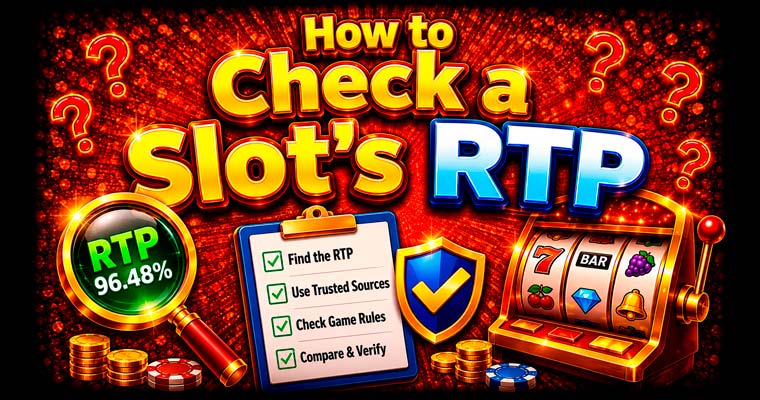
Start inside the game. Open the rules, help, information, or paytable menu and look for “Return to Player,” “RTP,” or “Theoretical Payback.” Record the percentage, casino, date, and game mode. Then compare it with the provider’s documentation and a current independent database.
How to Check a Slot’s RTP: Step by Step
Use the real casino and game mode you are considering. A demo hosted by a provider or database may not prove which configuration the casino uses.
Common icons include “i”, “?”, a gear, or a menu symbol. Some providers place RTP near the bottom of a long rules document rather than on the first paytable screen.
Look for “RTP,” “Return to Player,” “Theoretical RTP,” “Theoretical Payback,” or a statement of house edge. Do not confuse RTP with hit frequency, volatility, bonus probability, or jackpot contribution.
Some games use different models for optional modes such as Ante Bet, enhanced feature chance, Bonus Buy, jackpot eligibility, or a special max-bet meter. The rules should state whether a displayed percentage is combined, mode-specific, or conditional.
Save the percentage together with the casino, jurisdiction, date, game title, provider, and selected mode. A bare percentage without context becomes unreliable when a provider offers several versions.
Compare the result with the provider’s official game page or technical sheet and one current database. A provider page often shows a standard or headline configuration; the in-game rules are usually the most relevant evidence of the version deployed at that casino.
Game: Example Slot
Casino and market: Operator A, regulated market B
Displayed RTP: 94.50%
Provider headline RTP: 96.50%
Conclusion: This installation appears to use a lower approved configuration. The provider headline should not be used to describe the casino version.
Where Is RTP Usually Shown?
| Source | What it can tell you | Main limitation |
|---|---|---|
| In-game rules or help | The percentage presented for the deployed game or selected mode | Menus can be difficult to navigate; wording and disclosure vary by jurisdiction |
| Provider game page | Standard, maximum, or promoted figures and sometimes available configurations | May not identify the version selected by a particular casino |
| Technical sheet or certification document | Configuration-specific data and conditional modes | Often unavailable publicly or difficult to match to the deployed build |
| Independent slot database | Fast comparison across many titles and providers | May contain a default value, an old value, a copied error, or no version context |
| Casino lobby | Occasionally displays the figure before launch | Many lobbies show only title, image, provider, and promotional labels |
For UK-regulated remote games, the rules must provide information about how the game works and the likelihood of winning. That information may be expressed as RTP, house edge, or event probabilities. Other jurisdictions use different requirements, so do not assume every licensed game presents the number in the same place or format.
Why the Same Slot Can Show Different Values
Some providers supply several approved mathematical versions of one title. The operator chooses from the available configurations. The visible game can remain almost identical while symbol weights, prize probabilities, or feature contributions produce a different theoretical return.
At $1,000 of equal turnover, the theoretical cost in this example rises from $35 to $55 between the highest and lowest configurations. That is a difference in expected cost, not a prediction that one session will finish exactly $20 lower.
For the deeper explanation of provider configurations, certification, and operator selection, read Do Different Casinos Have Different RTP for the Same Slot?
Why Provider Pages, Reviews, and Databases Disagree
They are describing different configurations
The provider may list a headline or highest figure while the casino deploys a lower approved version. Both numbers can be genuine, but they describe different mathematical builds.
The database has no version field
A database entry may store one percentage for a title even though several exist. Without a field for jurisdiction, casino, release, or game mode, the number is incomplete.
The game has been updated or reissued
A provider can release a new build, market-specific edition, reskin, sequel, or migrated HTML5 version. Similar names and artwork do not guarantee identical math.
The displayed figure includes or excludes an optional component
Jackpot contribution, Bonus Buy, Ante Bet, enhanced feature chance, or other optional modes may have separate percentages. Read the surrounding rules rather than copying the first percentage you see.
A review copied another review
Unsourced values can propagate across affiliate sites. Several pages repeating the same number are not independent verification if they all inherited it from one old entry.
A search result, review, provider page, or SlotRandomizer card is useful for discovery. It does not replace the rules attached to the actual game installation.
Theoretical RTP vs Your Personal Results
A player cannot reliably verify the theoretical RTP by recording a few hundred or a few thousand spins. The observed return from a short sample is dominated by random variation, especially in high-volatility games where a large share of theoretical return may be concentrated in rare prizes.
Session return = total payouts ÷ total wagers × 100%
If you wager $500 and receive $425, your session return is 85%. That does not prove the game’s theoretical RTP is 85%, nor does it show that the slot is malfunctioning.
Use What Is RTP in Slots? for the distinction between the theoretical figure, house edge, turnover, and actual session return.
What If the RTP Is Not Shown?
- Check every rules and information tab, including legal, game rules, settings, and jackpot information.
- Confirm that the game has fully loaded and that you are viewing the correct real-money or demo mode.
- Search the provider’s official title page or documentation.
- Ask the operator’s support team for the figure and the exact game configuration.
- Save the answer and screenshot together with the date and game URL.
- If the figure remains unclear, do not assume the highest value from a database applies.
Missing or unclear information is not proof that a game is rigged. It is, however, a valid reason not to rely on that game for RTP-based comparison until the configuration is confirmed.
How to Shortlist Higher-Paying Games Without a Data Trap
Use a database to create a shortlist, not to make the final verification. Filter for a minimum RTP, select games that fit your volatility preference, and then confirm each shortlisted title inside the casino. This separates two tasks:
Use SlotRandomizer, provider pages, and databases to find candidates.
Use the deployed game rules to confirm the exact configuration and conditions.
For titles marketed around unusually high percentages, also check Slots With 99% RTP. That page covers the game-selection cluster; this page is about the verification process.
Verification Checklist
Use the randomizer to shortlist games by published RTP, volatility, provider, and max win. Verify the selected game inside the casino before playing.
Find slots to verify →Frequently Asked Questions
The UK Gambling Commission’s RTS 3 requires regulated remote games to provide rules and likelihood-of-winning information. The permitted presentation includes RTP, house edge, or event probabilities, so the precise display can vary.
UKGC RTS 3: Rules and likelihood of winningThe Bottom Line
The correct RTP is configuration-specific. Use databases and provider pages to discover games, but verify the percentage in the rules attached to the exact casino installation and mode you intend to use.