What Is Bonus Buy in Slots? How It Works and Is It Worth It?

What is bonus buy

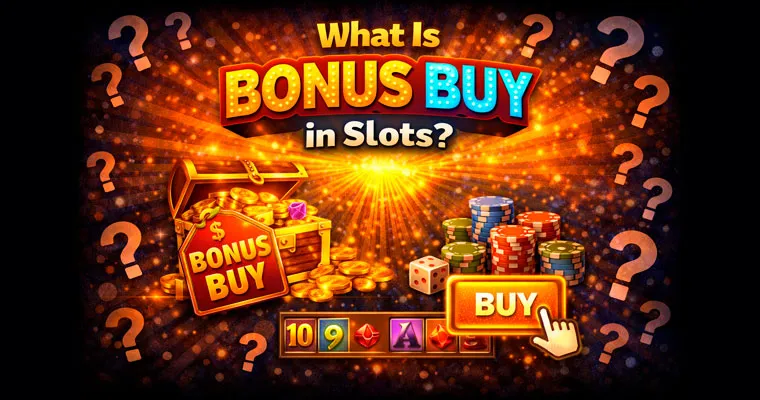
Bonus Buy (also called Feature Purchase or Buy Bonus) lets you skip the base game and pay a fixed price to trigger a slot’s bonus round immediately. It’s one of the most popular — and most misunderstood — features in modern slots. Some players love it for skipping the grind. Others use it as an accelerated way to burn through their bankroll. Here’s how it actually works, what it costs, and the math behind whether it makes sense.

How it works: Instead of waiting for scatter symbols to trigger the bonus naturally, you pay a fixed multiplier of your bet (typically 50x–100x, sometimes up to 2,000x) to instantly enter the bonus round. The bonus plays out identically to a naturally triggered feature.

The key fact: Most individual Bonus Buy purchases return less than their cost. The feature is priced so that the average return is slightly below the purchase price — this is how the house edge applies. Buying the bonus doesn’t improve your expected value; it concentrates your betting into the highest-variance part of the game.

How Bonus Buy Works: Step by Step

1
A “Buy Feature” button appears on the game screen

Most games that offer Bonus Buy display the option near the spin button or in the game menu. Not all slots have this feature — it depends on the provider and the specific game.

2
You choose the feature and see the price

The cost is expressed as a multiplier of your current bet. At $0.20/spin with a 100x Bonus Buy, the price is $20. Some games offer multiple buy tiers at different prices for different bonus types.

3
You pay the full cost in one transaction

The purchase price is deducted from your balance immediately — not spread across spins. This is the critical difference: instead of spending $20 over 100 spins at $0.20 each (with some base game returns along the way), you spend $20 in a single moment.

4
The bonus round plays out normally

The feature you purchased plays identically to one triggered naturally. The RNG determines the outcome just as it would if you’d landed scatter symbols. In most implementations, the bonus round’s RTP is the same whether bought or triggered. Some providers note slight RTP differences for bought vs triggered bonuses in their paytables — always check.

What Does Bonus Buy Cost?

The price varies by game, provider, and which bonus tier you’re buying. Here are typical ranges across the most common implementations:

Provider Feature Typical Cost Example Game
Pragmatic Play Free Spins 100x bet Gates of Olympus, Sweet Bonanza
Pragmatic Play Ante Bet (enhanced trigger) 1.25x bet (per spin) Gates of Olympus, Sugar Rush
Hacksaw Gaming Standard Buy 80x bet Wanted Dead or a Wild
Hacksaw Gaming Premium Buy 200x–400x bet Wanted Dead or a Wild (enhanced)
Nolimit City Standard Spins 60x–100x bet San Quentin xWays
Nolimit City Premium / Lockdown 400x–2,000x bet San Quentin xWays (Lockdown)
Relax Gaming Feature Buy (multiple tiers) 20x / 50x / 100x / 500x bet Money Train 3 (tiers vary by starting conditions)
Push Gaming Not offered Jammin’ Jars (no buy option)
Ante Bet vs Bonus Buy — they’re different

Bonus Buy: One-time purchase at 50x–2,000x bet. Instantly triggers the bonus round.

Ante Bet: A small per-spin surcharge (typically 25% extra, so 1.25x normal bet) that increases the probability of triggering the bonus naturally. You still play the base game — you just trigger the feature more frequently. Pragmatic Play offers Ante Bet on many titles alongside traditional Bonus Buy.

Ante Bet is less volatile than Bonus Buy because the cost is spread across many spins and you still receive base game wins. However, your effective RTP may differ slightly — check the paytable for the specific game.

The Math Behind Bonus Buy

Why most Bonus Buys return less than they cost

Simplified example: Imagine a game with a 100x Bonus Buy where the average bonus round returns around 80x. The provider has built in a margin between the purchase price and the average payout. In practice, the exact ratio varies by game — some are tighter, some wider — but the principle holds: the purchase price is set above the average return.

This means: over many purchases, you will lose money on Bonus Buy. Individual buys can return 500x or more — or return 5x. But the average return is designed to be below the purchase price. This is mathematically identical to any other form of slot play: the house edge applies.

The difference is speed and concentration. A 100x Bonus Buy compresses what might take 100+ spins of base game wagering into one moment. You skip the base game’s “recycle” wins (small payouts that partially return your money along the way) and go directly to the highest-variance event. You aren’t just saving time — you’re paying a premium to concentrate your entire financial risk into a single RNG event.

Does Bonus Buy Change the RTP?

In most implementations, the overall RTP is designed to be similar whether you use Bonus Buy or play naturally. However, there are nuances worth knowing:

Some providers publish slightly different RTPs for bought vs triggered bonuses. This is disclosed in the game’s paytable or rules section — always check before buying. While the absolute difference may look small (1-2%), in casino math terms this can represent a significant shift in house edge. For example, if a game’s standard RTP is 96% (house edge 4%) and the bought bonus RTP is 97% (house edge 3%), the house edge has decreased by 25% in relative terms — a meaningful difference over repeated purchases.

Additionally, when you use Bonus Buy, you skip the base game — which has its own RTP contribution. The base game’s small, frequent “recycle” wins (wilds, minor combinations) partially offset your wagering during normal play. Buying the bonus eliminates this cushion: you pay full price in one transaction with no partial returns along the way. This doesn’t necessarily mean worse overall RTP — but it means a very different risk profile.

When Bonus Buy Makes Sense vs When It Doesn’t

When it can make sense

You want to sample a game’s feature: One buy to see how the bonus plays — especially useful when evaluating a new game before committing to a longer session.

You have a deep bankroll and time is limited: If you can afford 3-5 buys and accept that most will return below cost, buying lets you experience the game’s high-variance moments without hours of base game grinding.

The game’s base game is extremely sparse: On some extreme-volatility games, the base game returns almost nothing. Here, the “cost” of playing naturally includes hundreds of empty spins. Bonus Buy lets you skip that — but remember you’re also skipping the small recycle wins that partially offset your wagering cost. You’re paying a premium for time savings, not getting the feature cheaper.

When it doesn’t make sense

Your budget allows only 1-2 buys: Bonus Buy is high-variance. With only 1-2 attempts, you’re likely to get below-average results and end your session immediately.

You’re chasing losses: Buying bonuses to “get back” money lost in the base game is the fastest path to bankroll destruction. Each buy is an independent event with negative expected value.

You treat it as a default strategy: Repeated buying at 100x is extremely expensive. Five buys at $0.40/spin = $200. Most of those buys will return less than $40.

The game has a good base game: Some slots deliver meaningful base game returns (frequent wilds, respins, small features). Skipping that means losing a real part of the game’s value.

Bonus Buy and Casino Wagering Requirements

An important practical consideration: many online casinos exclude Bonus Buy from contributing to bonus wagering requirements, or count it at a reduced rate (often 10-20% instead of 100%). This means:

If you’re playing with a deposit bonus and need to clear a wagering requirement, using Bonus Buy may not count toward your progress — or may count very slowly. Wagering rules are operator-specific and can differ even within the same regulatory market — always check your casino’s terms before buying. Some casinos go further and disable the Bonus Buy button entirely while a bonus is active.

This restriction exists because Bonus Buy concentrates wagering into high-variance events, which makes it easier for players to clear requirements quickly with a lucky hit — something casinos want to prevent.

Bonus Buy Is Banned in Some Countries

Not every player has access to Bonus Buy. Several regulated markets have restricted or banned the feature:

Regulatory status (as of 2026)

United Kingdom: Bonus Buy is banned. The UK Gambling Commission prohibited feature purchases in 2019, citing concerns about accelerated gambling speed, creation of an “illusion of control” for the player, and the concentrated financial risk of high-cost single transactions that can dramatically accelerate loss rates.

Spain: Banned under responsible gambling regulations.

Sweden: Restricted. Temporary play limits have affected Bonus Buy availability at various points.

Many other jurisdictions: Available at licensed casinos, though availability depends on local regulations and individual operator policies.

Regulatory positions can change. If Bonus Buy isn’t visible on a game you’re playing, it may be disabled for your jurisdiction rather than absent from the game.

Popular Slots with Bonus Buy

Game Provider Buy Cost RTP Max Win
Gates of Olympus Pragmatic Play 100x 96.50% 5,000x
Sweet Bonanza Pragmatic Play 100x 96.48% 21,100x
Gates of Olympus 1000 Pragmatic Play 100x 96.50% 15,000x
Wanted Dead or a Wild Hacksaw Gaming 80x / 200x / 400x 96.38% 12,500x
Money Train 3 Relax Gaming 20x / 50x / 100x / 500x 96.10% 100,000x
San Quentin xWays Nolimit City 100x / 400x / 2,000x 96.03% 150,000x
Sugar Rush Pragmatic Play 100x 96.50% 5,000x
Starlight Princess Pragmatic Play 100x 96.50% 5,000x
RTP & max win note

RTPs are default (highest published) values — your casino may run a lower configuration, especially for Pragmatic Play games which offer multiple tiers. Max wins are advertised theoretical ceilings, not typical outcomes. Always verify the in-game RTP before buying or playing.

How to Evaluate a Bonus Buy Before Using It

Quick checklist — ask before you click “Buy”

1. What’s the purchase price in real money? At your current bet level, convert the multiplier to dollars. 100x at $0.40 = $40. Is that an amount you’re genuinely comfortable losing entirely?

2. Does the bought bonus have the same RTP? Check the paytable. Some games offer slightly different RTP for purchased vs naturally triggered bonuses.

3. Can your bankroll absorb multiple buys? One buy is a coin flip at best. If your budget allows only 1-2 buys, you’re almost certainly going to get below-average results and end your session.

4. Is the base game actually sparse enough to justify skipping? Some games return meaningful value through base game features (wilds, respins). Skipping them means skipping real partial returns.

5. Are you buying because you want to — or because you’re chasing? If your last buy lost money and you’re buying again to “get it back,” stop. Each buy is an independent event. Previous outcomes don’t influence the next one.

Find slots with Bonus Buy sorted by RTP, volatility, max win, and provider — and see the data before you decide whether to buy or spin naturally.

Explore Bonus Buy slots →

Frequently Asked Questions

What is Bonus Buy in slots?
A feature that lets you pay a fixed price (typically 50x–100x your bet) to instantly trigger the game’s bonus round, instead of waiting for it to trigger naturally through scatter symbols. The bonus plays out identically to one triggered by normal gameplay.

Is Bonus Buy worth it?
On average, no — the purchase price is designed so that the average return is below the cost. Individual buys can return many times the cost, but over many purchases you’ll lose money. Bonus Buy is useful for skipping empty base game spins or sampling a game’s feature, but it’s a volatility amplifier, not a value generator. Only use it when your bankroll can absorb multiple buys without pressure.

Does Bonus Buy change the RTP?
In most implementations, the overall RTP is designed to be similar whether you buy or trigger naturally. Some providers publish slightly different RTPs for bought bonuses — this is disclosed in the paytable. The practical difference is that Bonus Buy skips the base game’s contribution to total RTP, concentrating your play into the bonus round only.

What is the difference between Bonus Buy and Ante Bet?
Bonus Buy is a one-time purchase that instantly triggers the bonus. Ante Bet is a per-spin surcharge (typically 25% extra) that increases your chance of triggering the bonus naturally — you still play the base game and receive base game wins. Ante Bet is less volatile because the cost is spread across many spins.

Why is Bonus Buy banned in the UK?
The UK Gambling Commission prohibited feature purchases in 2019 over concerns about accelerated gambling, loss-chasing behavior, and the concentrated financial risk of high-cost single transactions. Players in the UK can still play the same games — they just can’t buy the bonus and must trigger it naturally.

Does Bonus Buy count toward wagering requirements?
Often no, or at a reduced rate. Many casinos exclude Bonus Buy purchases from wagering contribution entirely, or count them at 10-20% instead of 100%. Check your casino’s bonus terms before using the feature — some casinos disable the buy button while a bonus is active.

How many Bonus Buys should I budget for per session?
If you choose to use Bonus Buy, budgeting for at least 3-5 purchases gives you slightly more varied outcomes than a single buy — though even 5 buys is an extremely small statistical sample and not enough to draw conclusions about the game’s real return rate. Never allocate your entire session budget to a single buy. For practical bankroll advice, see our guides for small budgets and deeper bankrolls.

The Bottom Line

Bonus Buy is a volatility accelerator. It skips the base game and takes you straight to the bonus round — the most variable part of any high-volatility slot. It doesn’t improve your expected return. It doesn’t change the RTP. It concentrates your risk into a single high-stakes moment.

Used selectively and with clear awareness of the cost — to sample a game’s feature or skip a base game that returns almost nothing — it has a legitimate place in some players’ approach. Used repeatedly, impulsively, or as a loss-chasing mechanism, it’s one of the fastest ways to deplete a bankroll. Know the cost, check the RTP, and only buy when you can genuinely afford to lose the purchase price entirely.

Scroll to Top