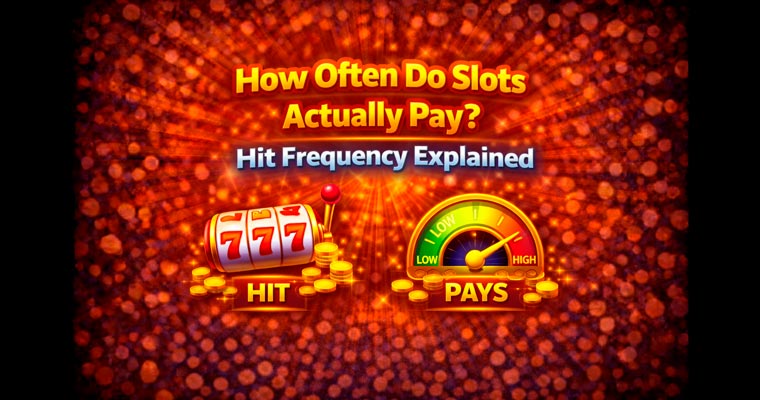
How often a slot pays is described by its hit frequency, also called hit rate or win frequency. It is the percentage of spins that produce any payout. The number is useful, but easy to misread: a payout can be smaller than the amount wagered, and an average of one win every four spins does not mean that every fourth spin must win.
Hit frequency is the percentage of spins that return any prize. A slot with a 25% hit frequency produces a payout on roughly 1 in 4 spins over a very large sample. A 10% hit rate means roughly 1 in 10.
It does not measure profitability. Wins below the stake still count as hits, so a slot can pay frequently while the player’s balance continues to fall.
What Hit Frequency Actually Measures
Hit frequency answers one narrow question: how many spins produce a payout? It does not reveal the average size of those payouts, how often the main bonus appears, or how much of the total wagered money is returned over time.
Those other properties are described by RTP and volatility. Hit frequency explains the rhythm of the base game: whether a session tends to contain regular small payouts or longer stretches without a win.
In most published hit-rate figures, any positive payout counts as a hit, including a return smaller than the original stake. However, providers do not all disclose or define the statistic in exactly the same way. Check the game rules before comparing figures from different sources.
How to Calculate Slot Hit Frequency
Hit frequency = winning spins ÷ total spins × 100%
If 250 out of 1,000 spins produce a payout, the observed hit frequency is 25%.
The corresponding average interval is calculated as 1 ÷ hit frequency. At 25%, the long-run average is one payout per four spins.
A player can calculate an observed hit rate from a personal session, but a short sample does not reveal the game’s exact mathematical hit frequency. Random variation can produce very different results across hundreds or even thousands of spins. The designed figure, when disclosed, is based on the complete game model rather than one player’s results.
How Often Do Slots Pay Out?
There is no universal payout interval for all slots. The answer depends on the individual game’s hit frequency. The table below converts several example rates into average intervals and dry-streak probabilities.
| Hit frequency | Average interval | 10 losing spins in a row | 20 losing spins in a row |
|---|---|---|---|
| 10% | 1 payout per 10 spins | 34.9% | 12.2% |
| 15% | 1 payout per 6.7 spins | 19.7% | 3.9% |
| 20% | 1 payout per 5 spins | 10.7% | 1.2% |
| 25% | 1 payout per 4 spins | 5.6% | 0.3% |
| 30% | 1 payout per 3.3 spins | 2.8% | 0.08% |
| 35% | 1 payout per 2.9 spins | 1.3% | 0.02% |
Probability of N losing spins = (1 − hit frequency)N
At a 20% hit frequency, the probability that a specified sequence of 20 spins contains no payout is 0.820, or about 1.2%.
This is the probability for one specified sequence starting at a particular spin. The chance of encountering at least one such streak somewhere in a long session is higher because the session contains many possible starting points.
An Average Is Not a Schedule
A 25% hit rate does not create a repeating pattern of three losses followed by one win. It means that payouts account for roughly one quarter of outcomes across the full mathematical model. A slot can produce several wins close together and then go many spins without one.
A losing streak does not make the next spin more likely to pay. In a standard RNG slot, each spin is generated independently from the same configured outcome distribution. The game is not tracking a debt that must be repaid after a fixed number of losses. For the broader explanation, see how slot RNG works.
Why “Paying Out” Is Not the Same as Making a Profit
A $1 spin that returns $0.30 normally counts as a winning spin for hit-frequency purposes. The reels formed a paying combination, but the player still lost $0.70.
Payouts below the stake are often described as losses disguised as wins, or LDWs, especially when they are accompanied by celebratory sounds and animations.
This is why a high win frequency should not be treated as evidence that a slot offers better value. A game can produce many small payouts and still have a lower RTP than a game that pays less frequently.
Assume 100 spins at $0.20 per spin, for $20 wagered in total.
Game A: 30% observed hit rate. Thirty spins return something, but most payouts are below the $0.20 stake. The session returns $15.
Game B: 12% observed hit rate. Only twelve spins return something, but several payouts are larger. The session returns $18.
The example is illustrative rather than a prediction. It shows why the number of winning spins and the amount returned are separate variables.
Hit Frequency vs RTP vs Volatility
These three metrics describe different parts of a slot’s mathematics. None can be substituted for another.
Measures: How often any payout occurs.
Usually shown as: A percentage.
Useful for: Estimating how active or sparse the base game may feel.
Does not show: Payout value or long-term return.
Measures: The theoretical share of total stakes returned across the full model.
Usually shown as: A percentage.
Useful for: Comparing long-run house edge.
Does not show: How often individual wins occur.
Measures: How returns are distributed by size and frequency.
Usually shown as: Low, medium, high or a provider-specific scale.
Useful for: Understanding bankroll swings and win-size distribution.
Does not show: An exact win frequency.
Does High RTP Mean Frequent Wins?
No. A high-RTP slot can have a low hit frequency if more of its theoretical return is concentrated in less frequent, larger outcomes. A lower-RTP slot can have a high hit frequency if much of its return comes through small payouts.
Does High Hit Frequency Mean Low Volatility?
Not necessarily. Low-volatility games often pay more frequently, while high-volatility games often produce longer gaps between meaningful wins. But hit frequency is only one part of volatility. A game can record many small hits while reserving a large share of its return for rare bonus outcomes, creating a more volatile experience than the headline hit rate suggests.
Base-Game Hit Rate vs Bonus Trigger Frequency
Hit frequency and bonus frequency are not interchangeable. A provider may report one or both of the following:
Base-game hit frequency: How often a regular spin produces any payout.
Feature or bonus trigger frequency: How often free spins, Hold and Win, or another main feature is activated.
A slot can produce frequent small base-game wins while triggering its main bonus rarely. Conversely, a feature may trigger comparatively often but have a wide range of possible returns. Exact trigger rates vary materially by title, bet mode and optional features, so generic figures should not replace the rules for the specific game.
Some slots also offer Bonus Buy or Ante Bet modes. These can change the price of a spin, the probability of triggering a feature, or the RTP configuration. The effect should be stated in the game rules rather than assumed from the standard base game.
How Slot Mechanics Affect Win Frequency
Reel layout and payout mechanics influence hit frequency, but they do not let a player calculate it from appearance alone. More paylines, more ways to win, a larger grid or a cascade system can create more possible paying combinations, yet providers balance those possibilities through symbol probabilities, payout values and trigger requirements.
Paylines and Ways to Win
More active paylines or ways can increase the number of combinations capable of paying. However, many additional hits may be small relative to the total stake. Read more about how paylines work and Megaways mechanics.
Cluster Pays and Pay-Anywhere Games
Cluster-pay and pay-anywhere games use group-size thresholds rather than fixed lines. Grid size alone does not reveal hit rate because symbol weighting and the minimum winning cluster are equally important.
Cascades and Tumbles
In a cascading slot, one paid spin may create several consecutive wins after symbols disappear and new ones fall into place. Databases may count the initial paid spin or individual cascade events differently, so definitions matter when comparing hit-rate figures.
Where to Find a Slot’s Hit Frequency
Hit frequency is less consistently disclosed than RTP. Check the following sources in order:
Game rules or info screen: Look for “hit frequency,” “win frequency,” “hit rate” or an equivalent term.
Official provider page or game sheet: Some providers publish mathematical specifications for individual releases.
Regulatory or technical documents: Detailed probability reports may contain the figure, although many are not public.
Third-party slot databases: Useful as a lead, but check whether the number is provider-supplied, estimated or copied from another source.
If no exact figure is available, volatility can provide a rough indication of session style, but it is not a substitute for hit frequency. Avoid inventing a percentage from a short demo session.
How to Use Hit Frequency When Choosing a Slot
1. Check RTP. It describes the game’s theoretical long-run return and house edge.
2. Choose volatility. Use it to match the game’s likely swings to your bankroll and preferred session style. See the comparison of low-, medium- and high-volatility slots.
3. Use hit frequency as a rhythm indicator. A higher rate usually means fewer empty spins, but not necessarily more profitable spins.
4. Check feature rules. Bonus trigger frequency, Ante Bet and Bonus Buy modes may matter more than the base-game hit rate.
Use the randomizer to narrow games by RTP and volatility, then check the rules of each shortlisted slot for any published hit-frequency or feature-trigger data.
Find a slot by RTP and volatility →Frequently Asked Questions
The Bottom Line
Hit frequency tells you how often a slot produces any payout, not how much money it returns. A high hit rate can include many payouts below the stake, while a lower rate can concentrate return into fewer, larger outcomes.
Use hit frequency to understand the likely rhythm of play. Use RTP to compare long-run return and volatility to assess the distribution of wins and bankroll swings.