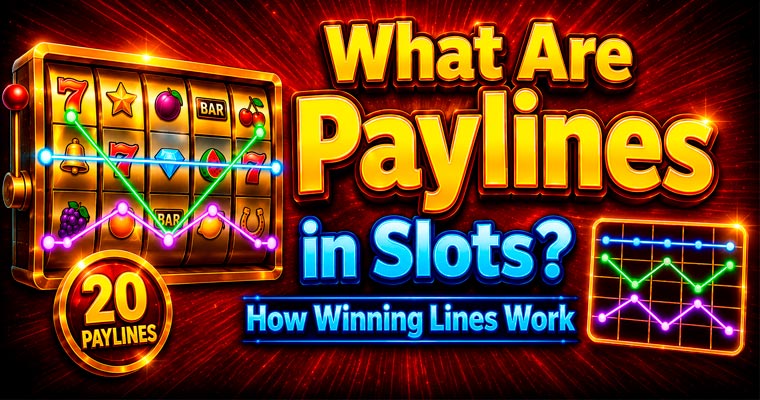
A payline is a predefined sequence of reel positions used to evaluate a line win. It can be horizontal, diagonal, V-shaped, zigzagged, or another pattern shown in the rules. The number of paylines says how many patterns are evaluated—not how high the RTP is or how often the game must pay.
A payline tells the game where matching symbols must appear. The rules also define direction, required consecutive reels, substitution, active lines, payout unit, and whether one symbol can contribute to several wins.
How a Payline Win Is Evaluated
A typical five-reel line game checks whether eligible symbols occupy the required positions on an active pattern. The same visible symbol arrangement can win on one payline and lose on another.
The rules must establish:
- which positions belong to each line;
- how many matching symbols are required;
- whether symbols must be consecutive;
- where the sequence must begin;
- whether wins pay left-to-right, right-to-left, or both ways;
- how Wild substitution works;
- how simultaneous line wins are added;
- which wager unit the paytable multiplies.
Do Line Wins Have to Start on Reel 1?
Many conventional line slots require matching symbols on consecutive reels beginning from the leftmost reel. That is common, not universal.
| Direction rule | Example interpretation |
|---|---|
| Left to right | The qualifying sequence begins on the leftmost eligible reel |
| Both ways | The game evaluates the same line from either side |
| Any starting reel | Adjacent matches can begin elsewhere if the rules allow it |
| Scatter exception | Scatter or Bonus symbols follow separate count or position rules |
NetEnt’s Starburst is a documented example of a 10-line game whose regular wins pay both ways. That does not mean all 10-line slots use the same direction rule.
Common Payline Shapes
Uses one row across consecutive reels.
Rises or falls across the grid.
Moves toward or away from a central row.
Alternates among rows according to the displayed line map.
A “20-line slot” can use 20 different patterns across the same 5×3 grid. It does not require 20 visible rows.
Fixed and Selectable Paylines
| Type | Player control | Key consequence |
|---|---|---|
| Fixed paylines | All lines are active automatically | The interface usually shows one total wager |
| Selectable paylines | The player can activate fewer or more lines | Coverage and possibly total wager change |
| Fixed lines with adjustable denomination | Line count remains fixed | Coin value or total bet changes the cash exposure |
A symbol arrangement that would pay on an inactive line produces no line award. Check whether bonus or jackpot eligibility also depends on active lines or coin settings.
Line Bet, Coin Value and Total Bet
Total bet = active paylines × bet per line
With 20 active lines at $0.05 per line, the total wager is $1.
That formula is common, but some interfaces use coins, credits, denomination, total bet, or package-based wagers. The displayed number must be read together with the paytable.
At $0.05 per line, the cash award is $5.
At a $1 total wager, the cash award is $100.
The same multiplier can therefore represent very different cash values.
Do More Paylines Improve the RTP?
Activating more lines can increase the number of eligible patterns. If bet per line remains constant, it also increases total turnover per spin. That does not establish a higher RTP.
Some selectable-line games can use different return calculations when fewer lines or coins are active, especially where jackpots or top awards require full eligibility. Other games keep percentage return broadly proportional. The paytable is authoritative.
Paylines Compared with Other Payout Systems
| System | What forms a win |
|---|---|
| Paylines | Matching symbols follow a predefined pattern |
| Ways to Win | Eligible symbols land on adjacent reels, usually in any visible row |
| Megaways | Ways can change as reel heights change |
| Cluster Pays | Connected groups of matching symbols meet a size rule |
| Pay Anywhere / Scatter Pays | A required count appears anywhere under the game’s rule |
Cascading is not itself a payout system. It describes what happens after a qualifying win: symbols are removed and the grid is refilled. A payline, Ways, Cluster, or Pay Anywhere game can all use cascades.
How Wilds and Scatters Interact with Lines
A Wild commonly substitutes for eligible line symbols. A Scatter often uses a separate count or position rule and therefore may not need to follow a payline. Neither behavior is universal.
See Wild and Scatter Symbols Explained.
Payline Checklist
- How many paylines exist?
- Are all lines active?
- Which direction is evaluated?
- Must wins begin on a particular reel?
- What does one line or coin cost?
- Are payouts based on line bet or total bet?
- Do jackpot or bonus rules require all lines or maximum coins?
- Can one spin produce several line wins?
Discover line, Ways, Cluster and Pay Anywhere games, then verify the active rule map.
Explore slot mechanics →Frequently Asked Questions
The Bottom Line
A payline is a position pattern, not a generosity measure. Check direction, active-line settings, payout unit, and eligibility rules before interpreting a line count.