A slot Random Number Generator supplies unpredictable values that the game converts into outcomes according to its approved rules and mathematical model. In a conventional online reel slot, the process is broadly: the player initiates a spin, the game requests one or more random values, those values are mapped to reel stops or another outcome table, and the selected result is displayed. The exact algorithm, number of RNG calls, timing, and mapping method vary by platform and game.
The important distinction: the RNG supplies randomness; the game model gives each possible result its probability and payout. A random selection process can still produce a fixed long-run RTP because the reel strips, weighted outcomes, paytable, and feature rules are programmed in advance.
The Outcome Chain
This chain is deliberately general. Some games make separate RNG calls for multiple reels, feature choices, or stages. Others select from a weighted outcome table or use a different approved method. Technical standards evaluate each implementation rather than requiring every slot to use one universal sequence.
Some gaming devices use background cycling or continuously changing state, but standards also permit other methods that preserve unpredictability. The player-facing conclusion is the same: timing a button press does not provide access to the hidden RNG state or a repeatable way to select a winning result.
Software, Hardware and Mechanical RNGs
Gaming standards recognize more than one source of randomness:
Uses a computer algorithm and an internal state. This is the common model for remote slot platforms.
Derives randomness from physical electronic phenomena such as circuit noise or other entropy sources.
Uses physical processes such as wheels, balls, tumblers, or shufflers. A mechanical display driven by a computer-selected result is still evaluated as a computer RNG implementation.
What Is a PRNG?
A software RNG is commonly a pseudo-random number generator. It uses an algorithm and an internal state to produce a sequence of values. If an attacker knew the exact algorithm, complete internal state, and all relevant inputs, a deterministic generator could theoretically be reproduced. Regulated interactive systems therefore require strong resistance to prediction and compromise.
“Pseudo-random” does not mean that the casino can see the next result. It means the random-looking sequence is produced computationally rather than by directly measuring a physical event. For real-money interactive gaming, GLI-19 requires the RNG used for outcome determination to be cryptographically strong.
Seeds, Entropy and Internal State
The seed establishes the initial state of a software RNG. A secure implementation must avoid predictable or identical initialization. Entropy may come from operating-system facilities, hardware events, or another approved unpredictable source. The exact method is implementation-specific and is normally not exposed to players.
The RNG state then changes as values are generated. Standards allow several ways to preserve unpredictability, including background cycling, discarding an unpredictable number of values, re-seeding, or mixing fresh entropy into the state. This is why it is inaccurate to say that every slot “resets” on a fixed schedule.
Re-seeding is a security and unpredictability mechanism. It does not create a payout cycle, make a machine due, or compensate for previous wins and losses.
How Random Values Become Reel Symbols
An RNG value is not automatically a cherry, Wild, Scatter, or jackpot. The game must convert the value into an outcome. Regulators call this process mapping. GLI standards also evaluate scaling and shuffling because a correct generator can still produce a biased game if the conversion step is implemented incorrectly.
A Common Virtual-Reel Model
In a conventional reel-based slot, each virtual reel is an ordered strip of positions. Symbols can appear several times, and the strips can differ from reel to reel. A random value is mapped to a stop on each reel, after which the visible window shows the selected stop and neighboring positions.
Suppose a virtual reel contains 128 equally selectable stops. If one symbol occupies 16 stops, its probability on that reel is 16/128. If another symbol occupies one stop, its probability is 1/128.
The RNG values can be uniformly distributed while the symbols are deliberately non-uniform because the reel strip contains different numbers of each symbol.
This is only one model. Grid slots, cluster games, instant-win products, jackpot systems, and multi-stage features may use weighted tables, several random selections, or other approved processes. The correct technical description is therefore RNG output plus game-specific mapping, not always “one random number divided by the number of reel stops.”
Virtual Reels and Near Misses
A displayed symbol being just above or below a payline does not show that the player was statistically “close” to a jackpot. The visible arrangement is the presentation of the selected stops. Technical standards also prohibit a game from selecting one losing outcome and then making a secondary variable decision to substitute a more dramatic losing display after the result has been selected.
The separate article on slot near misses should own the psychological and reel-design discussion; this page only explains the mapping layer.
When Is the Result Determined?
For a conventional chance-based slot, the game result is selected during the initiated play and is then displayed through the reel animation. The animation does not normally create a second opportunity to change the selected result. Quick Spin, Turbo mode, and skipping animations alter presentation time rather than the approved probability model.
The exact technical moment and call sequence are platform-specific, so the safest formulation is not “every slot captures a continuously generated number at the exact microsecond of the button press.” The defensible statement is: the initiated game uses approved RNG output to select the result, and the displayed outcome must correspond to that selection.
How Online Slots Decide Who Wins
In a regulated online slot, the outcome is determined server-side. The game client in the browser or app sends the spin request; the random selection and outcome evaluation run on the supplier’s gaming platform or another approved server component, and the client receives the finished result to display. GLI-19 is written for this architecture: the interactive gaming system, not the player’s device, generates and records the outcome.
Three practical consequences follow. Clearing the cache, switching devices, reinstalling the app, or changing connection speed cannot alter what the server selects. A dropped connection does not erase a result: regulated platforms record the outcome and restore or settle the interrupted round according to the game rules. And there is no “client-side pattern” to read, because the decisive values never originate in the browser.
Who wins a shared jackpot or network prize is likewise resolved by the platform’s rules and random values — not by which player clicked at the “right” moment. For the cryptographic model that lets players verify individual results, see the provably fair comparison.
RNG vs RTP: Why Random Does Not Mean 50/50
Supplies unpredictable values and supports independence between random draws.
Convert those values into symbols, features, prizes, and losing outcomes with their intended probabilities.
Is the expected return generated by the complete probability and payout model over a large volume of play.
A fair random die averages 3.5 without any roll being steered toward that number. A slot behaves similarly: each game result can be unpredictable while the weighted average of all possible payouts produces a fixed theoretical RTP.
How Lower RTP Versions Work
When a provider offers several approved RTP configurations, the versions can use different reel strips, symbol weights, paytable values, feature probabilities, or another documented mathematical change. It is not necessary to weaken the RNG. The random selection process can remain compliant while the distribution to which it is mapped changes.
See different RTP versions of the same slot and how to check the deployed RTP for the operator-facing part of this topic.
Independence and Adaptive Behaviour
For ordinary independent slot spins, knowledge of a previous random draw should not provide information about a future draw. GLI-19 also states that games must not change bonus likelihood because of awards in previous games or adapt theoretical return based on past payouts, except where a different behavior is explicitly part of the approved game design.
This distinction matters for persistence mechanics. A game may openly store progress toward a meter, collection feature, or must-drop jackpot. That is not evidence that the RNG is remembering losses in secret; it is a disclosed rule that changes the game state. Always read the rules before applying the simple “every spin is identical” explanation to a persistent feature.
Does Bet Size or Manual Reel Stopping Change the RNG?
Changing the monetary stake does not give the player access to a different hidden random-number stream. However, the published game rules may attach different eligibility, paytables, jackpots, ante features, or probabilities to a particular wager option. Those are disclosed model differences and must be evaluated separately.
Stopping a reel animation early normally changes only how quickly the already selected result is displayed. A game in which timing or skill genuinely affects the monetary outcome must disclose that behavior. This topic can later be expanded on the dedicated page about stopping slot reels without duplicating the RNG explanation here.
How RNG Testing Works
Independent testing is not limited to asking whether raw numbers “look random.” GLI-11 and GLI-19 require review of the source code that affects randomness, including core RNG, scaling, mapping, shuffling, and related functions. The laboratory then tests final outcome output for the intended distribution and independence.
Checks implementation errors, bias, malicious logic, and undisclosed parameters that could influence fair play.
Can include distribution, runs, serial-correlation, overlap, duplicate, and other tests appropriate to the implementation.
Verifies that scaling and conversion from RNG values to final outcomes do not introduce unintended bias.
Checks independence between draws and, where relevant, between several values used within one draw.
Under GLI-19, the applied statistical tests are evaluated collectively at a 99% confidence level. That does not mean a game has a “99% chance of being fair”; it describes the evaluation threshold used for the testing battery.
Certification Is Jurisdiction-Specific
GLI standards are technical reference standards, not a single worldwide law. Each regulator decides which requirements, laboratories, submissions, and ongoing controls apply. The UK Gambling Commission, for example, requires random outcomes to be “acceptably random” and prohibits compensated or adaptive behavior.
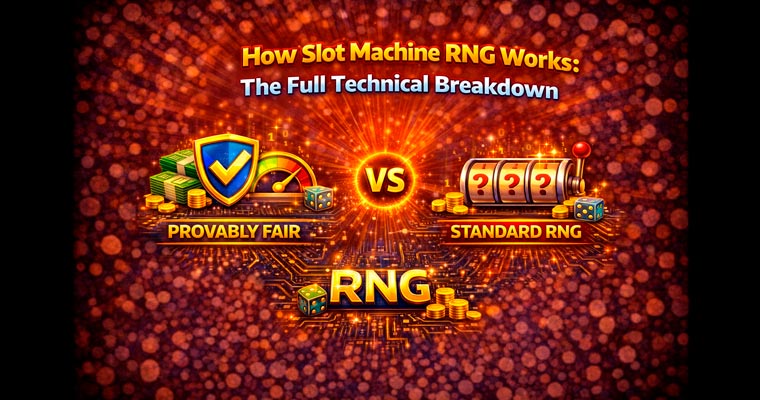
Standard RNG vs Provably Fair
A conventional regulated slot relies on an approval and audit chain: supplier controls, laboratory testing, operator compliance, and regulatory oversight. A provably fair game adds a cryptographic procedure that can let a player verify a specific result or sequence after the fact.
These are different verification models, and “provably fair” is not automatically a replacement for game certification, consumer protection, or correct payout rules. See Provably Fair vs Standard RNG for the dedicated comparison.
Use SlotRandomizer to compare the published RTP, volatility, provider, and max win. Then verify the exact game version and rules before play.
Explore the slot database →Frequently Asked Questions
The Bottom Line
A slot result comes from an approved random-selection process plus a programmed probability and payout model. Do not confuse randomness with equal odds, or one common implementation with a rule that applies to every platform.