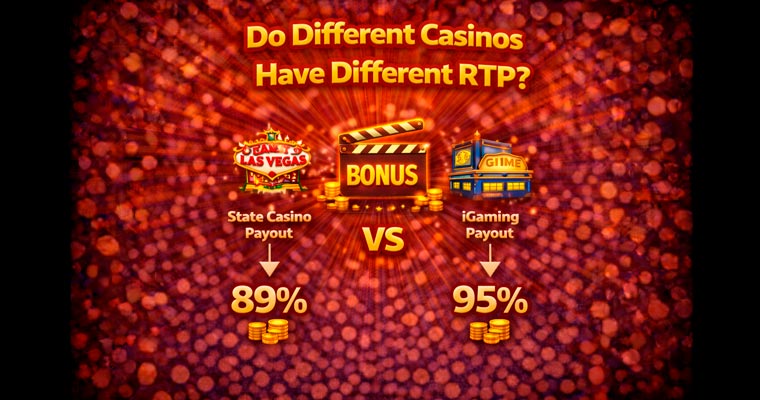
The same slot title can have a different theoretical return at different casinos when the supplier offers more than one approved mathematical configuration. The name, artwork, and feature labels may remain similar while the paytable, symbol weighting, feature probability, or another part of the approved model changes.
Yes — but not every game has selectable RTP. The supplier defines the available versions, and the operator or platform deploys one of the versions permitted for that market. The reliable figure is the RTP shown in the player-facing rules of the exact game installation, not a review-site headline.
How Multiple RTP Versions Work
A supplier can submit several approved versions of a game. Each version has its own theoretical return and supporting mathematical documentation. The operator does not create an arbitrary percentage; it deploys a version supported by the supplier, platform, and applicable regulatory approvals.
Supplier responsibility
Build and document the available mathematical models, game rules, paytables, and return calculations.
Operator responsibility
Select and deploy a permitted version, provide accurate player-facing rules, and manage updates through controlled procedures.
Player verification
Check the active figure inside the game and record the casino, market, version, date, and selected mode.
Some products have only one approved configuration. Others have several. It is therefore inaccurate to claim that every modern provider offers three, five, or eight versions of every title.
What Can Differ Between RTP Versions?
A lower-return version does not have to alter one obvious number in the paytable. Depending on the design, the difference can come from:
- reel strips or virtual symbol weights;
- paytable values;
- bonus or jackpot contribution;
- feature-trigger probabilities;
- feature payout distribution;
- optional-mode mathematics;
- a combination of several parameters.
The visible theme and feature names can remain unchanged. The game should still follow the rules and probability model of the deployed approved version.
A reduction from 96% to 94% does not prove that bonuses trigger less often. The supplier could change bonus values, base-game awards, jackpot allocation, symbol weighting, or several components. Only version-specific documentation can identify the mechanism.
How Much Does a Lower RTP Version Cost?
Expected loss = turnover × (1 − RTP)
| RTP | House edge | Expected loss per $1,000 turnover |
|---|---|---|
| 96.5% | 3.5% | $35 |
| 95.0% | 5.0% | $50 |
| 94.0% | 6.0% | $60 |
Moving from 96.5% to 94.0% raises the house edge from 3.5% to 6.0%. That is a 71.4% relative increase in expected loss per unit of turnover. It is still a long-run comparison, not a prediction for one session.
How to Verify the Active RTP
Demo versions, review screenshots, and provider pages can describe another configuration.
Look for “Return to Player,” “Theoretical RTP,” “Payout Percentage,” or house-edge information.
Base game, Feature Buy, jackpot, enhanced-chance, or another option can display a separate return.
Save the game title, provider, casino domain, date, market, stake or denomination, and displayed RTP.
Do not compare a base-only RTP with another game’s total RTP or a Bonus Buy figure with ordinary play.
See How to Find and Check a Slot’s RTP for the complete verification workflow.
What Must Be Disclosed?
Disclosure rules depend on the jurisdiction. Under UK Gambling Commission RTS 3C, information that allows the customer to make an informed decision about the likelihood of winning must be easily available before gambling. This can include RTP, house edge, or event probabilities.
The UKGC also defines theoretical RTP as the designed return advertised in the player-facing rules. This makes the in-game rules the appropriate source for the version offered to the customer in that regulated deployment.
A supplier may publish one standard or headline RTP. That confirms a documented product value but does not prove that every operator uses that same version.
Why Would an Operator Select a Lower Version?
The direct economic effect is a higher theoretical margin per unit of turnover. Operators may make the decision as part of pricing, market positioning, promotional economics, tax, supplier agreements, or other commercial considerations.
Those motives should not be inferred for a particular casino without evidence. The observable facts are the deployed RTP, the applicable rules, and the operator’s commercial offering.
Can the Casino Change RTP While You Are Playing?
In a compliant deployment, an operator cannot casually adjust or manipulate the return: a change is a controlled product or configuration update—not a per-player button used to alter the next spin. Procedures differ by architecture and jurisdiction, but changes affecting game mathematics can require testing, release control, logging, and deployment outside an active wager.
It is therefore too broad to say that RTP can never change during any session under any architecture. The accurate boundary is that an ordinary approved game must not adapt theoretical return because a specific player won, lost, deposited, or changed balance.
For the wider operator-control question, use Can Casinos Control Slot Machines?.
Different RTP Does Not Mean the Game Is Rigged
A lower approved and accurately disclosed configuration is not the same allegation as counterfeit software or outcome manipulation. It is a less favorable product version. Fraud and game-authenticity checks belong on Do Online Casinos Rig Slots?.
Use SlotRandomizer’s RTP as a discovery benchmark, then verify the active value inside the exact casino game.
Compare published slot data →Frequently Asked Questions
The Bottom Line
The title identifies the game family; the player-facing rules identify the deployed mathematics. Verify the exact RTP and mode at the exact casino, and compare versions by expected cost rather than appearance.