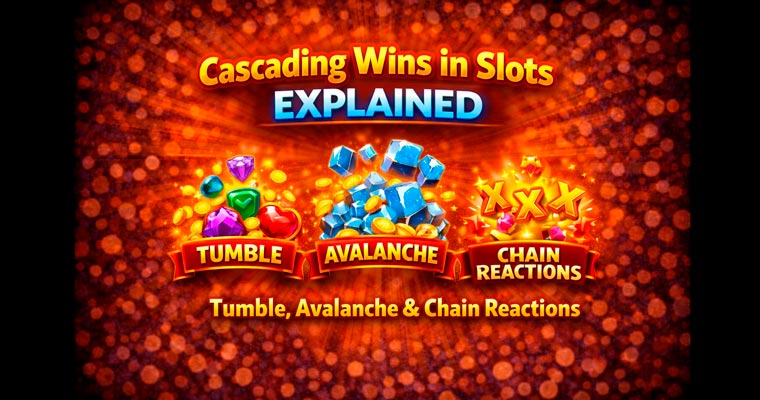
Cascading wins describe a post-win process: qualifying symbols are removed or transformed, the grid is refilled, and the game evaluates another result within the same paid game round or feature step. Tumble, Avalanche, Rolling Reels, and similar names can describe related implementations, but the exact refill and multiplier rules differ.
Cascade is not a payout system by itself. It can follow a payline win, Ways win, Cluster win, or Pay Anywhere win. The underlying system decides what counts as a win; the cascade rule decides what happens next.
How a Cascade Sequence Works
The reels or grid produce an initial arrangement.
Payline, Ways, Cluster, or symbol-count rules determine whether a win exists.
Some games remove all winning symbols; others preserve Wilds, split symbols, or special positions.
Symbols can fall from above, shift sideways, expand the grid, or be generated through another documented rule.
The process continues until no new qualifying win or another stated end condition remains.
Is Every Cascade a New Spin?
Usually no. Several cascades can belong to one paid game round. The game may display each stage as a separate win event while accumulating a sequence total that is credited at the end.
Important consequences:
- the player normally pays once for the initial base-game round;
- cascade stages can share a multiplier or persistent state;
- hit-frequency definitions can count the original spin, each cascade, or another event unit;
- maximum-win rules can terminate the sequence;
- a bonus spin can contain its own cascade sequence.
A cascade is another evaluation inside the current round. Free Spins are a separately awarded sequence of game rounds.
Cascade vs Payout System
| Combination | What creates the initial win | What the cascade changes |
|---|---|---|
| Payline + Avalanche | Symbols follow predefined line patterns | Winning symbols disappear and the reels refill |
| Ways + Cascade | Matches land on adjacent reels | New symbols can create new Ways combinations |
| Cluster + Cascade | Connected groups reach the required size | Removed clusters create new grid connections |
| Pay Anywhere + Tumble | A required count appears anywhere | Removed symbols are replaced and the count is checked again |
This separation prevents a common error: calling every cluster game a cascade slot or every tumble game a Scatter Pays game.
How Cascade Multipliers Work
Increases with each consecutive cascade and resets when the sequence ends.
Can persist across several Free Spins or feature steps.
Attaches to a cell and applies when a later win uses that position.
Applies when a multiplier symbol participates or lands during an eligible win.
Multiple multipliers can add, multiply, select the highest, or follow another rule. Never infer the combination method from the icons alone.
Do Cascades Improve RTP or Increase Volatility?
Cascades are already part of the game’s approved mathematical model. Adding the mechanic does not by itself improve RTP. A cascade game can have higher, equal, or lower RTP than a non-cascade game.
The mechanic also does not guarantee high volatility. Volatility depends on the complete distribution: how often the first win occurs, how often chains continue, multiplier behavior, feature probability, payout caps, and symbol values.
They change sequence structure and presentation. One paid round can contain several linked evaluations, and later stages can use accumulated state.
Official Examples
Gonzo’s Quest: Avalanche over a line game
NetEnt describes Gonzo’s Quest as using Avalanche instead of traditional spins, with increasing multipliers and Free Falls. The original game has a fixed 5×3 layout and 20 paylines.
Gates of Olympus 1000: Pay Anywhere plus Tumble
Pragmatic Play states that at least eight matching symbols anywhere on the 6×5 grid create a win. The Tumble feature removes winning combinations and replaces them with symbols falling from above.
Gonzo’s Quest II: expanding grid during Avalanches
NetEnt’s 2025 sequel shows why “refill” is not always a fixed-grid drop: each win can expand the reels while Avalanches continue, and the grid resets when the chain ends.
Cascades and Megaways
A Megaways cascade can refill reels whose visible heights vary under the game rules. The number of ways can therefore change between stages. This is a game-specific design, not a universal feature of all Megaways titles.
Checklist for a Cascade Game
- What payout system creates the first win?
- Which symbols are removed or preserved?
- How does the grid refill?
- When does the chain stop?
- Does a multiplier increase, persist, or reset?
- How are multiple multipliers combined?
- Is the sequence counted as one paid round?
- Can the max-win cap terminate it?
Find cascade games across different payout systems, then compare the exact refill and multiplier rules.
Explore cascade slots →Frequently Asked Questions
The Bottom Line
Cascade describes the continuation after a win, not the rule that created the win. Separate payout system, refill logic, multiplier state, and settlement to understand the game correctly.