How Slot Bonus Rounds Are Triggered: Scatter Rules, Random Triggers, and Mystery Features

How Slot Bonus Rounds Are Triggered

You know bonus rounds exist. You know they’re where the big wins happen. But how exactly does a slot decide to launch one? The trigger mechanics vary far more than most players realize — and understanding them changes how you evaluate a game before you play it.

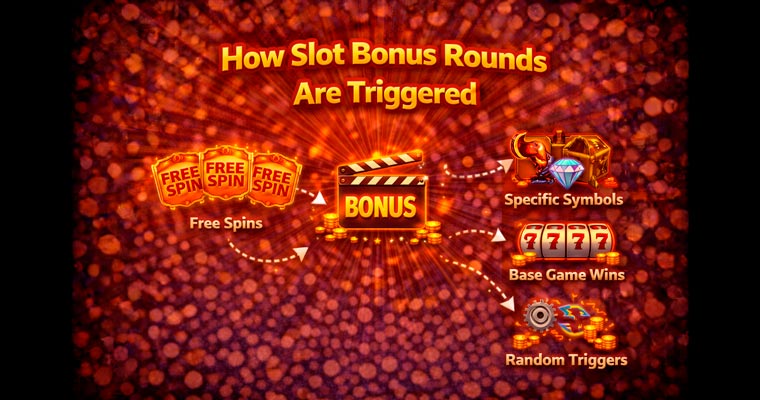
Slot bonus rounds are triggered through several distinct mechanics: scatter symbol combinations (the most common), random triggers with no symbol requirement, multi-spin collection meters, single-spin threshold systems like Hold & Win, cascade chains, mystery symbol reveals, and the bonus buy shortcut. The RNG governs all of them — no trigger can be forced, predicted, or influenced by bet timing.

Scatter Symbol Triggers: The Standard Mechanic

The vast majority of online slots use scatter symbols as the primary bonus trigger. The core rule is simple: land a minimum number of scatter symbols anywhere on the reels in a single spin, and the bonus round activates. Position doesn’t matter — scatters don’t need to fall on a payline or appear on consecutive reels.

The standard threshold is three scatters, but this varies by game design. Most 5-reel slots require three or more. Some Megaways and multi-reel slots require four or more, depending on the reel layout and intended bonus frequency — more symbol positions in view means a higher threshold to maintain the target trigger rate. Scatter-pays games (like Gates of Olympus or Sweet Bonanza) may require four to six scatters, with the number affecting what you receive — more scatters usually means more free spins or a higher starting multiplier.

A critical rule that catches new players off guard: wilds cannot substitute for scatters in the vast majority of slots. If you have two scatters and a wild, the wild does not count as a third scatter. This is an intentional design choice — if wilds could replace scatters, bonuses would trigger far too frequently, fundamentally breaking the game’s volatility profile and math model. The notable exception is the “Book of” slot family (Book of Dead, Book of Ra, and similar titles from Play’n GO and Novomatic), where a single symbol functions as both wild and scatter simultaneously — always documented in the paytable.

The psychology of the second scatter

Game designers know that two scatters in view create the most powerful anticipation moment in slots — the “will the third one land?” tension. Providers enhance this with deliberate reel slowdowns and sound effects when the final reel spins. This is purely presentational. The outcome was already determined by the RNG the instant you pressed Spin. The dramatic pause changes nothing about the result — it’s engineered to amplify the emotional response, whether you hit the trigger or not.

In most games, landing more scatters than the minimum grants additional rewards. A common structure: 3 scatters = 10 free spins, 4 scatters = 15, 5 scatters = 20. Some games also pay a scatter payout (a multiplier of your total bet) on top of launching the bonus — so the scatters both trigger the feature and pay you before the free spins begin.

Retriggering follows the same logic. During free spins, if you land the required number of scatters again, additional spins are added to your remaining count. Some games cap retriggers (Pragmatic Play titles often limit to a specific maximum). Others allow unlimited retriggering — though the probability per spin remains the same, so infinite retriggering is theoretically possible but practically rare.

Random Triggers: No Symbols Required

Some slots can launch a bonus feature on any spin without requiring a specific symbol combination. For the player, these feel like random activations — a losing spin is suddenly interrupted by a bonus wheel or a feature round. The specific implementation varies by game: some use a separate probability layer within the math model, others tie the trigger to hidden conditions. The common thread is that no visible scatter landing is needed.

Microgaming’s Mega Moolah is the most famous example: its progressive jackpot wheel can appear after any base game spin. The feature is tied to qualifying bets, but the exact trigger mechanism and weighting are not publicly disclosed by the developer.

Random triggers also include base game modifiers that fire without warning. Pragmatic Play’s Ante Bet modifier doubles the probability of scatters appearing in exchange for a 25% increase in total bet cost — you pay 1.25x your normal wager, and the scatter trigger chance roughly doubles. NetEnt’s random feature triggers in games like Guns N’ Roses (where Encore Free Spins or the Crowd-Pleaser can activate on any spin) follow a similar principle. These aren’t always full bonus rounds — some are brief single-spin enhancements — but the underlying mechanic is the same: the activation doesn’t depend on a visible scatter combination.

Mystery Symbols and Reveal Mechanics

Mystery symbols are not a separate trigger type — they’re a reveal layer that can contribute to any of the above triggers. These placeholder icons (question marks, blank tiles, themed objects) land on the reels and then transform into the same randomly selected symbol. If they transform into scatters, the result is a scatter trigger. If they transform into regular symbols, they contribute to payline wins. The outcome was determined by the RNG at spin time; the transformation is just the visual reveal.

Some providers lean heavily on this mechanic. In Nolimit City’s Mental, for example, mystery symbols can transform into the Patient Scatter — without this pathway, the bonus trigger would be extremely rare given the game’s high volatility. Hacksaw Gaming uses similar mid-spin transformations that can convert near-misses into trigger completions. Understanding that mystery symbols are a delivery mechanism rather than an independent trigger type helps you read paytables more accurately.

Collection Meters and Multi-Spin Persistence

A growing category of bonus triggers doesn’t rely on a single spin at all. Instead, specific symbols or events are collected over multiple spins, filling a visible meter or progress bar. When the meter reaches its threshold, the bonus activates.

This mechanic is sometimes called “persistence” or “accumulation” because progress carries forward across spins. Examples include games where landing a specific symbol adds a token to a tracker, and after collecting a set number of tokens, a feature unlocks. Some Hacksaw Gaming titles (like Chaos Crew 2) use this approach — collecting special symbols across many spins fills a gauge that eventually triggers a bonus state.

Progress bars: what’s real and what’s illusion

In true persistence systems, a half-filled meter does mean you’re closer to the activation threshold — the progress is real and banked. But the probability of the next qualifying symbol landing on any given spin hasn’t changed. Each individual spin is still independent. The meter tracks how much has already happened, not how likely the next event is. The psychological trap is conflating “I’m closer to the threshold” with “I’m more likely to trigger on my next spin.” Those are different claims, and only the first one is true.

Single-Spin Threshold Triggers: Hold & Win and Cascades

Hold & Win (also called Hold & Spin, Lock it Link, or Cash Collect) works differently from multi-spin collection. Landing a threshold number of special symbols on a single spin — typically six coin or money symbols in Pragmatic Play’s implementation — triggers a respin sequence. Those symbols lock in place, the remaining positions respin a fixed number of times (usually three), and each new qualifying symbol resets the respin counter. This is a single-spin trigger that leads into a persistence-like respin state.

Cascade (Tumble/Avalanche) triggers activate when consecutive wins within a single paid spin reach a threshold. In tumble-mechanic slots, winning symbols are removed and new ones fall in; if another win forms, the cascade continues. Some games trigger a bonus after a specific number of consecutive cascades — for example, 4–5 consecutive tumble wins in a single round. This is effectively a single-spin trigger with a variable-length qualification sequence.

Bonus Buy: Paying to Skip the Trigger

The bonus buy feature eliminates the trigger mechanic entirely. Instead of waiting for scatters or random events, you pay a premium (typically 60x–100x your base bet) to enter the bonus round immediately. The game simulates the scatter landing that would have triggered the feature, and the bonus plays out normally from there.

This is relevant to trigger mechanics because it reveals something about the math: bonus buy pricing reflects the expected value and natural rarity of the feature, combined with the target RTP for that mode and provider design choices. It’s not a clean one-to-one conversion into “average spins until bonus” — volatility, payout distribution, and margin structure all factor in. But broadly, a more expensive buy suggests a rarer or higher-value feature.

Bonus buy is not available in all jurisdictions. The UK’s Gambling Commission banned the feature for operators holding a UKGC license, citing concerns about accelerated spending. However, it remains legal and widely available in most other regulated markets — Malta, Curaçao, Gibraltar, Ontario, and others — provided the RTP for the buy mode is clearly displayed. Players in restricted markets must trigger bonuses through the standard mechanics described above.

Trigger Types at a Glance

Trigger Type How It Activates Player Control Example
Scatter symbols 3+ scatters anywhere in one spin None Book of Dead, Gates of Olympus
Random trigger Any spin, no symbol requirement None Mega Moolah jackpot wheel
Collection meter Tokens collected over multiple spins Indirect (play contributes progress) Chaos Crew 2
Hold & Win threshold 6+ special symbols in one spin None Hot Fiesta, Gold Party
Cascade chain 4–5+ consecutive tumble wins None Cluster-mechanic tumble slots
Mystery reveal Mystery symbols transform into scatters None Mental (Nolimit City)
Bonus buy Pay 60–100x bet to enter directly Full (costs money) Most modern non-UKGC slots

How Trigger Mechanics Affect Your Experience

A note on terminology: “bonus trigger frequency” is not the same as hit frequency. Hit frequency measures how often any spin returns something (including small wins below your bet). Bonus frequency measures only how often the feature round activates. A slot can have a 35% hit frequency but trigger its bonus only once every 150–200 spins. Both are factored into the game’s RTP, but they describe different aspects of how the game plays.

The trigger type shapes how a game feels far more than most players realize:

Scatter-triggered games create a specific anticipation pattern. You see scatters land one at a time, building tension. Two scatters in view creates the “will the third one land?” moment that defines slot excitement. The visual buildup is part of the design.

Random-triggered games feel different because there’s no buildup. One spin you’re in base game, the next spin a bonus appears. This creates a lower-tension base game but with sudden spikes of excitement. Games with random triggers often compensate with more frequent but smaller bonus events.

Collection-meter games create a sense of progression that other trigger types lack. Each spin feels like it contributes to something, even when it doesn’t pay. This design exploits the same psychological mechanisms as loyalty programs and progress bars — visible advancement toward a goal.

None of these trigger types changes the underlying math. The game’s RTP and hit frequency already account for how often bonuses trigger and what they pay. A game with rare triggers will typically have higher-paying bonus rounds. A game with frequent triggers will have smaller average bonus payouts. The total expected return remains the same — it’s just distributed differently.

Want to find games with specific mechanics? Use the randomizer to filter by Bonus Buy availability, volatility level, and provider — each provider has signature trigger styles you’ll learn to recognize.

Explore the Slot Randomizer →

Frequently Asked Questions

Can you force a bonus round to trigger?
No. All trigger mechanics — scatter landings, random events, collection completions — are determined by the RNG. No betting pattern, timing strategy, or spin sequence can influence when a bonus triggers. The only exception is the bonus buy feature, which lets you pay directly for entry.
Why do some slots need 4 scatters instead of 3?
Games with more symbols in view (like Megaways titles with up to 117,649 ways or 6-reel scatter-pays games) require more scatters to maintain the intended trigger frequency. If a Megaways game only needed 3 scatters across its expanded reels, bonuses would trigger far too often, which would reduce their payout value to compensate.
Does bet size affect how often bonuses trigger?
For most slots, no — the probability of landing the required scatters is the same at any bet level. The exception is games with random triggers that are explicitly weighted by bet size (like some progressive jackpot games) and games with an Ante Bet modifier that increases scatter probability for a higher wager. Always check the game’s rules to see if bet size affects feature frequency.
Can wilds substitute for scatter symbols?
In the vast majority of slots, no. Wilds substitute for regular paying symbols to complete combinations on paylines, but they cannot replace scatters for bonus trigger purposes. A small number of games feature wild-scatter hybrid symbols that function as both — but these are clearly documented in the paytable.
What is a random bonus trigger?
A random bonus trigger is a feature activation that can occur on any spin regardless of which symbols land. The RNG independently decides whether to launch the bonus, separate from the visible reel outcome. The player has no control over or advance warning of the trigger. Microgaming’s Mega Moolah jackpot wheel and various base game modifiers in Pragmatic Play and NetEnt titles use this mechanic.
Every bonus trigger — scatters, random events, collection meters, mystery transformations, or bonus buy — is governed by the RNG. The trigger type shapes how a game feels but doesn’t change the underlying math. Understanding which mechanic a game uses helps you choose slots that match how you like to play.
Scroll to Top