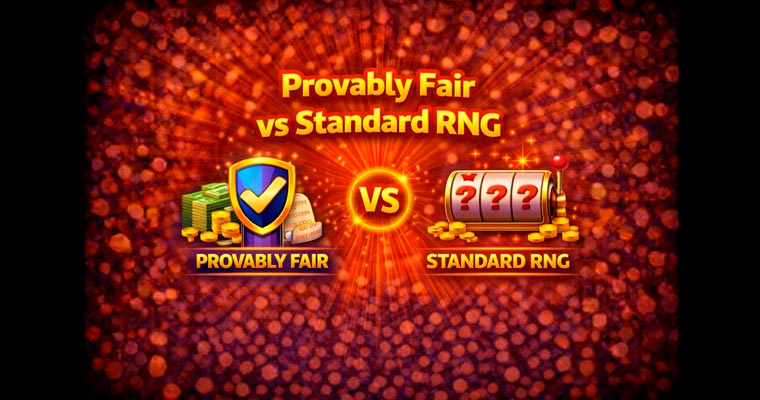
“Provably fair” and “certified RNG” are often presented as competing ways to generate randomness. That framing is incomplete. A provably fair game can also use cryptographic pseudo-random functions, while a certified casino game may use software, hardware, or mechanical randomness. The real difference is how a player obtains assurance: a cryptographic protocol can expose enough data to verify a specific historical result, whereas a conventional regulated game relies mainly on testing, release controls, monitoring, logs, and regulatory accountability.
Provably fair does not eliminate trust. It can prove that a revealed seed matches an earlier commitment and that a published deterministic calculation reproduces a result. It does not by itself prove that the payout table is favorable, the conversion from bytes to outcomes is unbiased, the interface used the advertised code, withdrawals will be honored, or the operator is properly licensed.
The Core Difference Is Verification, Not Randomness
Assurance through controlled review
An approved test house reviews the RNG, source code, scaling, mapping, and final outcome distribution. The regulator or licensee controls releases, test reports, updates, and monitoring. A player usually cannot recompute one spin from public inputs.
Assurance through reproducibility
The operator commits to hidden data before play and later reveals it. The player or a third party can reproduce the published calculation for a historical round and check whether the result is consistent with the commitment.
These models can coexist. A regulated game could add cryptographic per-round verification, and a provably fair game could still be submitted for laboratory testing. “Provably fair” is a protocol property, not a licence category and not proof that the entire casino is trustworthy.
How Certified RNG Assurance Works
A conventional remote casino game is evaluated as a complete system rather than by testing only a raw number generator. GLI-19 requires source-code review of core randomness, scaling, shuffling, mapping, and other functions affecting the final random outcome. Statistical testing is applied after mapping to check the intended distribution and independence.
The same standard requires monetary chance outcomes to be determined by approved RNG values under the game rules. It prohibits adaptive substitution of selected results and adaptation of theoretical return based on past payouts.
Under the UK Gambling Commission framework, remote games must produce acceptably random results, avoid compensated behavior, and follow the described rules and payouts. Licensees must submit game and RNG test reports, and testing must be completed before release.
The player receives indirect assurance: a tested build, a licensed deployment, published rules, round records, monitoring, complaint routes, and an accountable chain of supplier, operator, laboratory, and regulator.
The player normally does not receive the secret RNG state or enough inputs to reproduce one spin independently.
The detailed technical explanation belongs on How Slot RNG Works. This page is concerned with the difference in verification models.
How a Provably Fair Commit–Reveal Protocol Works
There is no single universal provably fair standard. Implementations differ in hash functions, keyed functions, seed order, external entropy, nonce handling, game-event conversion, and when verification becomes possible. The common pattern is a cryptographic commitment followed by a later reveal.
The operator generates a server seed or another secret input.
A cryptographic hash of the secret is shown before the relevant bets. The commitment is intended to prevent the server from replacing that secret later without detection.
A client seed, public event, or another input reduces the operator’s unilateral control over the final output. The timing of this input matters.
A nonce, round identifier, cursor, or counter produces different outputs without necessarily replacing the seed pair after every bet.
The protocol may use HMAC-SHA-256 or another published construction, followed by a game-specific conversion into dice rolls, card positions, mines, crash points, or other results.
After rotation or completion, the old server seed is disclosed. The player checks the original commitment and recomputes previous rounds.
Stake documents a server-seed hash shown before bets, a player-editable client seed, an incrementing nonce, and HMAC-SHA-256-derived bytes. Shuffle describes a similar commit-and-reveal sequence and requires seed rotation before the old server seed is revealed. These are examples of implementations, not a definition binding every provably fair game.
Why the commitment matters
A secure hash commitment is intended to be:
- Hiding: the published hash should not reveal the secret seed before play.
- Binding: after publishing the hash, the operator should not be able to reveal a different seed that produces the same commitment.
SHA-256 is designed with strong preimage and collision-resistance properties, while HMAC is a keyed construction used for message authentication and integrity. These primitives are components of a protocol; their presence alone does not prove that the complete casino implementation is correct.
A Critical Detail: Who Chooses What, and When?
The simplified claim “the server commits first, then the player supplies an unpredictable client seed” describes a strong ordering, but it is not guaranteed by the words provably fair. The protocol must be inspected.
The server publishes its commitment, then the player chooses or changes a client seed that the server could not predict when selecting its secret.
The operator knows the client seed before choosing the server seed. In principle, a malicious operator could search many candidate server seeds and commit to one producing a favorable future sequence.
The protocol mixes in a future public value that neither party can control at commitment time, such as an independently generated public event.
This is a protocol-level inference from the threat model: a commitment prevents changing the chosen secret after commitment, but it does not by itself prove that the secret was selected without bias before commitment. Player-controlled or external unpredictable input addresses that risk.
How to Verify a Provably Fair Result
Record the server-seed hash, client seed, nonce or round ID, game, and timestamp before the seed pair is rotated.
Rotate or close the seed pair using the platform’s documented procedure.
Hash the revealed server seed using the stated algorithm and confirm it equals the hash published before play.
Apply the published HMAC or hash construction to the server seed, client seed, nonce, cursor, and any other documented inputs.
Use the exact documented mapping from bytes to the game event. This step is essential: matching random bytes does not prove a displayed result if the conversion is wrong or incomplete.
Check the recomputed event against the round history, displayed result, paytable, and credited amount.
A built-in verifier can reproduce the platform’s calculation while sharing the same implementation error or misleading conversion. Higher assurance comes from published source code, documented test vectors, or a local independent implementation.
Shuffle’s help documentation illustrates the practical sequence: rotate the seed pair, obtain the revealed server seed, and re-enter the client seed, server seed, and nonce to reproduce the result.
What Provably Fair Does Not Prove
It does not prove favorable odds
A perfectly reproducible game can have a large house edge. Verification checks integrity against the published algorithm, not whether the payout model is generous.
It does not prove unbiased seed selection
A commitment binds the server to a chosen seed. Additional protocol design is needed to show that the operator could not select that seed after searching for a favorable sequence.
It does not prove correct mapping
Cryptographic output still needs to be converted into game outcomes. Biased scaling, hidden rejection rules, or incomplete documentation can undermine the claimed probabilities.
It does not prove the visible code was used
A verifier and a game interface can display the same documentation while the production server runs different code. Independent review, reproducible builds, or regulation can address this separate risk.
It does not prove payout settlement
The computed result may be correct while the wallet credits the wrong amount, voids a round, applies an undisclosed cap, or refuses withdrawal.
It does not verify third-party slots automatically
A crypto casino’s in-house dice or mines game may be provably fair while provider slots in the same lobby use conventional certified RNG systems.
It does not prove licensing or solvency
Cryptographic verification says nothing about custody of funds, KYC treatment, complaints, legal access, responsible-gambling controls, or whether balances are fully backed.
It does not prevent every implementation defect
Nonce reuse, ambiguous serialization, broken entropy, inconsistent byte order, undisclosed cursor logic, or an error in the verifier can invalidate the intended guarantee.
For counterfeit games, false licences, and account misconduct, use Do Online Casinos Rig Slots?. For long-run expected cost, use What Is RTP?.
Provably Fair vs Certified RNG Comparison
| Question | Certified RNG deployment | Provably fair protocol |
|---|---|---|
| Primary assurance model | Testing, controlled releases, monitoring, audit logs, regulator and supplier accountability | Cryptographic commitment and reproducible historical calculation |
| Can a player recompute one result? | Usually not from public data | Yes, if all inputs and the complete conversion function are disclosed |
| When is verification available? | Testing before release and institutional monitoring during operation | Usually after the server seed or committed secret is revealed |
| Who checks implementation? | Approved laboratory, supplier, operator, regulator, auditors | Player, community, independent reviewers—and optionally a laboratory or regulator |
| Is the outcome mapping reviewed? | It should be within the test scope, including scaling and mapping | Only if the conversion is fully published and someone checks it |
| Does it constrain house edge? | No; the approved rules and RTP can still favor the house | No; a reproducible payout model can still strongly favor the house |
| Does it verify withdrawals? | No, but licensing can provide account, complaint, and enforcement controls | No |
| Typical weakness | The player cannot directly inspect a single round and must verify the institutional chain | The protocol label can hide weak chronology, biased seed choice, incomplete mapping, or an unreviewed implementation |
| Can both be used together? | Yes. Per-round cryptographic verification and conventional testing address different risks. | |
Which Model Is Better?
Neither model is categorically superior in every dimension.
- the full protocol and game conversion are public;
- the player or external source contributes unpredictable input after commitment;
- independent implementations reproduce the same results;
- historical inputs and commitments are preserved.
- the test house reviews code, scaling, mapping, and final distribution;
- the deployment is tied to a verifiable regulated operator;
- major changes trigger retesting;
- round records, RTP monitoring, complaints, and enforcement are available.
The strongest practical model would combine both: public per-round verification for outcome integrity, independent technical review for the implementation and probability mapping, and regulatory controls for money custody, disclosures, account treatment, and disputes.
Fairness technology does not determine expected cost. Compare RTP, volatility, provider, and game rules separately.
Compare slot mathematics →Frequently Asked Questions
- GLI-19: Standards for Interactive Gaming Systems
- UKGC RTS 7: Generation of random outcomes
- UKGC game and RNG test-report requirements
- Stake provably fair implementation
- Shuffle commitment-scheme documentation
- RFC 2104: HMAC
- NIST hash-function security properties
Operator documentation is included to illustrate real implementations. It is not an independent certification of the operator or a universal provably fair standard.
The Bottom Line
Certified RNG asks whether a controlled system was properly tested and operated. Provably fair asks whether a historical result can be reproduced from data committed before play. Each model covers risks the other may leave open. Neither proves favorable odds or trustworthy handling of player funds.