Try it on a friend: “Quick — pick a number between 1 and 10.” More often than chance can explain, the answer is 7. Ask a chatbot, and you’ll often get 7 there too. This isn’t a coincidence or a conspiracy — it’s one of the clearest small demonstrations of a bigger fact about the human mind: we are remarkably bad at being random.
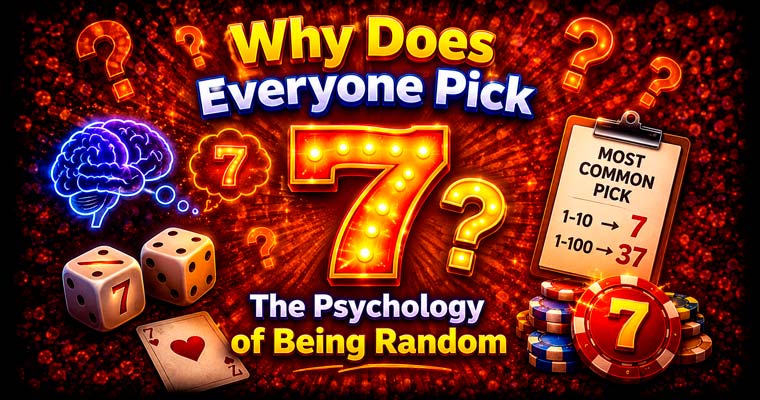
People disproportionately pick 7 because it feels like the “most random” choice: it’s odd, prime, sits away from the endpoints, and isn’t part of an obvious pattern like 5 or 10. The deeper truth is that humans are poor unaided generators of randomness — we avoid repeats, dodge “obvious” numbers, and follow shared biases so predictable that even AI models trained on our text inherit them.
The Experiment Everyone Fails
When people are asked for a number between 1 and 10, the picks don’t spread evenly. The endpoints (1 and 10) feel “too obvious.” Even numbers feel structured. 5 sits in the middle — too neat. What’s left is a small set of numbers that feel pleasingly arbitrary, and 7 wins that contest by a wide margin in informal polls and classroom experiments repeated for decades.
Stretch the range to 1–100 and the same psychology produces a new champion: 37. Popular crowd experiments — including the science channel Veritasium’s large 2024 video on the subject — have made 37 the best-known example, with 73 and other odd primes close behind. Notice the pattern: odd, prime, no round-number smell, digits that don’t repeat. We don’t pick randomly; we pick what looks random — and we all share the same idea of what that looks like, which is precisely why the result isn’t random at all.
The Blue-Seven Phenomenon
This bias is old enough to have a name in the psychology literature. In a 1971 study, researcher William E. Simon documented what became known as the “blue-seven phenomenon”: asked to name a color and a number, people disproportionately answer “blue” and “7”. The effect has been revisited and discussed for decades, although exact rates vary by sample and wording — the headline preference for 7 keeps showing up.
Seven also carries a cultural halo that reinforces the bias: lucky 7, seven days of creation, seven wonders. That halo is exactly why 777 became the universal jackpot symbol — slot designers didn’t invent the affection for 7; they inherited it.
Why Humans Can’t Be Random
Number preference is just the visible tip. Decades of “random generation” experiments — where people are asked to produce random-looking sequences of digits or coin flips — show systematic, repeatable failures:
We avoid repeats. A genuinely random coin will produce runs of five heads in a row more often than intuition expects. Humans writing a “random” sequence almost never allow that — long runs feel wrong, so we edit them out. Real randomness is streakier than we believe, which is also why normal losing streaks on a slot feel rigged when they aren’t.
We alternate too much. Asked to simulate coin flips, people switch between heads and tails far more often than chance would. Our internal model of “random” is actually “balanced” — and balance is a pattern.
We balance the books. After producing several high numbers, people feel pulled toward low ones. That’s the gambler’s fallacy operating inside your own head — the same instinct that whispers a slot is “due” after a drought.
These aren’t flaws of inattentive people; they show up in everyone, including people who understand randomness intellectually. Pattern-making is what brains are for. Randomness is the one thing they refuse to produce.
Why AI Picks 7 Too
Here’s the twist that makes this a 2026 story: large language models often fail the same test. In informal tests and, more recently, systematic studies of LLMs as random number generators, chatbots asked for a number between 1 and 10 pick 7 far more often than 10% of the time — and on larger ranges show a suspicious fondness for numbers like 37 and 42. The exact skew varies by model, settings, and phrasing, but the bias itself keeps being found.
The reason is elegant: these models learn from human text, and human text is saturated with our biases. An LLM predicting “what number follows this question” reproduces the answer humans most often gave. It didn’t learn to be random; it learned to be us. (Genuine randomness in software comes from a different place entirely — dedicated generators built and certified for the job, as we break down in how slot RNG works.)
What This Has to Do With How You Pick Slots
Everything, actually. The same brain that can’t pick a random number can’t browse a casino lobby randomly either. Players orbit the same handful of familiar games, “randomly” land on whatever the lobby’s recommendation row surfaced, and pick titles by the same odd-prime logic that picks 7 — it feels like free choice and runs on rails.
That’s the actual reason a randomizer is useful. Not superstition, not strategy — outsourcing. A neutral random pick across a full database does the one cognitive task your brain demonstrably refuses to do, and surfaces games from volatility tiers and providers your habits would never reach.
Your brain will pick 7. The randomizer makes a neutral database-wide pick from 8,000+ slots and 185+ providers — and shows you the RTP, volatility, and max win before you commit to anything.
Frequently Asked Questions
The Bottom Line
Everyone picks 7 because nobody is random. Human choices — numbers, colors, slots — run on shared, predictable patterns that feel like freedom from the inside. Even our AI models, trained on our words, inherited the same tell.
There’s no fixing the brain; there’s only knowing it. For numbers, that knowledge is a party trick. For choosing what to play, it’s the entire reason to let a real random generator do the picking.