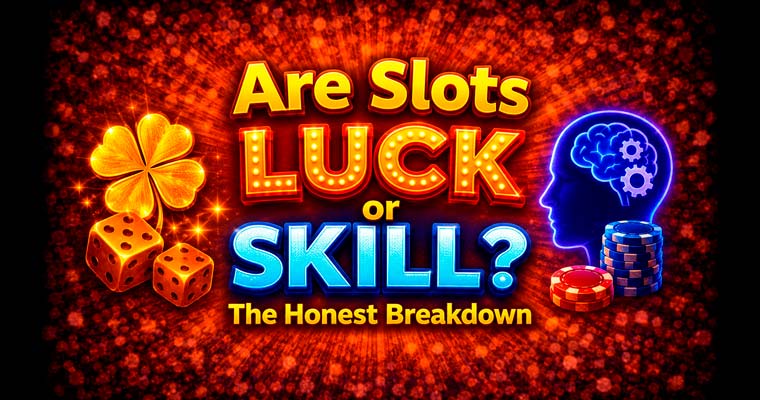
Standard casino slots are games of chance: the approved random process and paytable determine each monetary result. A player can still make meaningful decisions about which product to use, what stake to select, and when to stop. Those decisions affect expected cost and exposure, but they do not create control over the next ordinary spin.
Chance determines the result; decisions determine the terms on which the player accepts that chance. A higher-RTP version can reduce expected loss per unit wagered, and a lower stake can reduce monetary exposure. Neither turns an ordinary slot into a beatable skill game.
The Chance Layer
For an ordinary chance-based slot, monetary outcomes should be determined by the approved RNG values and the game rules. UKGC RTS 7 requires acceptably random outcomes and prohibits compensated behavior. GLI-19 prohibits adapting theoretical return based on past payouts.
The player does not improve the next outcome by:
- pressing Spin at a particular moment;
- using a rhythm or stop-button technique;
- changing games after a drought;
- following recent winners;
- tracking near misses;
- playing at a particular hour.
The Decision Layer
Choosing 98% RTP rather than 94% RTP reduces expected loss per equal unit of turnover. Verify the exact deployed version.
A lower stake reduces cash exposure per spin. It does not usually change percentage return unless the rules specify another paytable or mode.
Bonus Buy, Ante Bet, FeatureSpins, jackpot side bets, and cap choices can change price, probability, volatility, or RTP.
A preset loss limit restricts total exposure. It cannot turn negative expectation positive, but it can prevent additional unplanned turnover.
Stopping rules change how much is wagered and when play ends. They do not alter the expected return of each equivalent wager.
What About Skill-Based or Hybrid Gaming Machines?
Some regulated gaming devices are explicitly designed as games of skill or hybrid games. Nevada Regulation 14 requires devices in those categories to indicate prominently that player skill affects the outcome.
These products are separate from an ordinary chance-only slot. Their rules should explain:
- which action involves skill;
- how performance changes the award or probability;
- whether a minimum or maximum return applies;
- how chance and skill components interact;
- how the game identifies itself to the player.
A bonus screen that asks the player to pick an object is not automatically skill-based. The options can have equal expected value, random awards, or predetermined outcomes. A meaningful skill claim requires a documented relationship between player performance and result.
Controls That Feel Like Skill but Usually Are Not
| Control | What it usually changes | What to verify |
|---|---|---|
| Stop or slam-stop button | Animation duration | Whether the rules explicitly say performance affects the result |
| Autoplay | How spins are initiated | Jurisdictional availability and session controls |
| Bonus choice | Presentation or selection among options | Whether choices have different documented probabilities or expected values |
| Bet-size control | Cash exposure and possibly eligibility | Paytable, mode, jackpot, and RTP rules |
| Game switching | Which mathematical model is played | Active RTP and rules, not recent outcomes |
The UKGC’s online slot rules prohibit features such as slam stops that create an illusion of control over the outcome and prohibit autoplay for online slots in Great Britain. This is a market-specific design rule, not proof that every control in every jurisdiction behaves identically.
Slots Compared with Other Games
| Product | Can player decisions affect the game result? | Primary source of advantage or cost |
|---|---|---|
| Ordinary chance-based slot | No control over the random result | RTP, stake, volatility, and optional modes |
| Skill or hybrid gaming device | Yes, where the rules explicitly connect performance to outcome | Chance model plus documented skill component |
| Video poker | Yes, through card-hold decisions | Paytable and strategy |
| Blackjack | Yes, through hit, stand, double, and split decisions | Rules and strategy |
| Poker against players | Yes | Opponent skill, strategy, variance, and rake |
Use skill where it exists: verify the product, rules, RTP, and stake before accepting the wager.
Compare slot data →Frequently Asked Questions
The Bottom Line
Ordinary slots are chance games with controllable costs. Use decisions to select the product and limit exposure, not to claim control over the next random result. Skill-based and hybrid devices are separate products that must disclose how skill affects the outcome.