
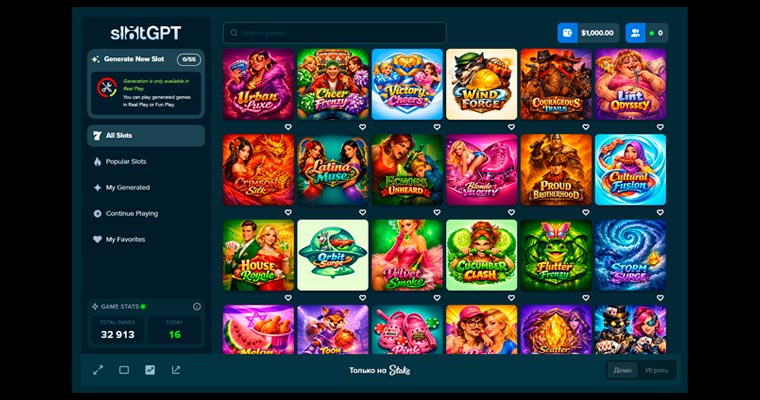
In late December 2025, crypto casino Stake launched SlotGPT — a tool that lets players type a text prompt and receive a playable slot game within minutes. By the end of its first week, more than 28,000 player-generated slots had reportedly been created (according to platform-reported figures). It’s one of the first large-scale real-money implementations of AI-generated slot games, and it raises genuine questions about how slots are made, verified, and evaluated. Here’s a neutral look at what SlotGPT is, how it works, what’s genuinely new about it, and where the important gaps are.
What SlotGPT is: An AI-powered slot generator exclusive to Stake.com. You describe a theme via text or voice prompt, and the AI creates a playable slot — visuals, symbols, music, mechanics — in 3-5 minutes. You can play it yourself or publish it for other players.
What it’s not: It’s not a traditional slot from a licensed provider like Pragmatic Play or NetEnt. The games aren’t independently certified by testing labs like GLI or BMM. The RTP is not publicly disclosed. And the max win is capped at 5,000x across all SlotGPT creations.
How SlotGPT Works
Describe your slot idea in plain language — theme, mood, visual style, setting. Text or voice input. Examples might range from “underwater pirate treasure” to “zen garden with sushi symbols.” The more specific the prompt, the more distinctive the result.
SlotGPT’s engine generates the visual components: symbol artwork, background visuals, music, sound effects, and reel presentation. It then maps these onto one of four pre-built game type templates. The AI appears to automate most of the visible creation workflow, but the underlying game mechanics — the math model, RNG, hit frequency, win distribution — are almost certainly based on these fixed templates, not generated fresh for each prompt. In practice, SlotGPT functions more as a high-speed reskin engine than a game design tool: you create the wrapper, not the math.
The generated slot goes through a content moderation process before publication. Slots with copyrighted, offensive, or inappropriate themes may be rejected. Not all prompts produce a published game.
Once approved, the slot appears in the SlotGPT lobby. You can play it in Fun Play (demo) or Real Play (real money/crypto). Other players can discover and play your creation. You can generate up to 55 slots per day.
SlotGPT: Key Specifications
| Parameter | Details |
|---|---|
| Platform | Stake.com (exclusive) |
| Launch | Late December 2025 |
| Operator | Easygo (also operates Kick.com) |
| Max win | 5,000x (fixed across all SlotGPT games) |
| Min bet / Max bet | $0.10 / $1,000 |
| Play modes | Fun Play (demo) + Real Play (real money) |
| Generation limit | Up to 55 slots per user per day |
| Game types | 4 mechanic types (dynamically selected) |
| RTP | Not publicly disclosed |
| Provably Fair | No public confirmation for SlotGPT specifically |
| Independent certification | No public confirmation found (GLI/BMM/eCOGRA) |
| Technology partners | Titan Gaming, Twist Gaming, Paperclip Gaming, AvatarUX, 18 Gaming, 1 Ace Studios, 1 Spin Interactive |
| Games created (by late Dec 2025) | 28,000+ (platform-reported) |
| License | Stake operates under a Curaçao license |
What’s Genuinely New About SlotGPT
The iGaming industry has been exploring AI in game development for some time — providers like BGaming and Endorphina have used AI to generate art assets for individual titles. But SlotGPT is the first implementation that automates the entire creation loop and puts it in the hands of players rather than studios.
Automated presentation layer: Visuals, audio, and reel presentation — all from a single text prompt. Previous AI applications in slots were limited to individual components (art for a specific game). SlotGPT automates the visible creation workflow end-to-end, though the underlying math models appear to come from a fixed set of templates.
Player-as-creator: Traditionally, slots are built by studios over months. SlotGPT lets any player generate a themed slot in minutes. This shifts the relationship between platform, provider, and player — even if the player is creating the theme rather than the math.
Scale: 28,000+ games (platform-reported) in under a week. No traditional studio could produce this volume of themed variants. However, since all games run on 4 underlying templates, this represents 28,000 visual variations across roughly 4 mathematical models — not 28,000 mechanically distinct games.
Community library: Players can discover and play each other’s creations, turning the slot catalog into a social, user-generated content layer.
What’s Missing — The Important Questions
RTP is not published. Unlike games from major providers, where RTP is disclosed in the paytable and verified by testing labs, SlotGPT doesn’t make its return-to-player data publicly available. This creates a significant transparency gap. Notably, since all SlotGPT games appear to run on just 4 underlying math templates, the platform would only need to disclose 4 RTP values — not thousands. The fact that even these template RTPs aren’t published suggests this is a commercial decision, not a technical limitation.
No publicly confirmed independent certification. Traditional slots from providers like Pragmatic Play or NetEnt are tested by labs like GLI, BMM, or eCOGRA against standards like GLI-11. No public documentation confirms that SlotGPT games undergo equivalent independent testing. Stake claims “fair outcomes” and RNG-based mechanics, but based on publicly available information, the verification model remains unclear.
Provably Fair status is ambiguous. Stake uses Provably Fair technology for many of its in-house “Originals” games. Whether this extends to SlotGPT-generated games specifically has not been publicly confirmed.
Moderation ≠ certification. SlotGPT games pass content moderation — a review of themes and visuals designed primarily to prevent copyrighted material (e.g., trademarked characters), offensive content, and PR risks. This is brand safety, not mathematical verification. Content moderation checks what the game looks like; certification checks whether its math model is fair. These are fundamentally different processes, and one does not substitute for the other.
AI-Generated Slots vs Traditional Provider Slots
Development: Months per game. Human designers, mathematicians, artists.
RTP: Published, lab-verified, regulator-approved.
Certification: GLI, BMM, eCOGRA, iTech Labs.
Mechanics: Deep, varied — cascades, Hold & Win, Megaways, multi-level bonuses.
Max wins: Varies widely (1,000x–150,000x+ depending on game).
Availability: Thousands of licensed casinos worldwide.
Development: 3-5 minutes per game. AI-generated from text prompt.
RTP: Not disclosed.
Certification: None confirmed publicly.
Mechanics: 4 template types (dynamically selected). Presentation varies; underlying math model does not. Simpler structure than complex provider games.
Max wins: 5,000x (fixed cap for all games).
Availability: Stake.com only (Curaçao license).
Who SlotGPT Is For (And Who It Isn’t For)
Creative experimentation: If you’re curious about seeing your own slot idea come to life and want to test it in demo mode, SlotGPT is a genuinely novel experience.
Casual entertainment: As a novelty feature within an existing Stake account, generating and browsing community-created slots adds a social/creative layer to the platform.
Content creators and streamers: The “create and play your own slot live” format is inherently watchable and shareable — this is clearly part of Stake’s strategy.
Players who evaluate games by RTP: Without published RTP, you can’t make an informed comparison with traditional slots. If RTP matters to you (and it should), traditional provider games offer more transparency.
Players who want deep mechanics: SlotGPT’s 4 game types are a limited palette compared to the depth of mechanics in games from Nolimit City, Hacksaw Gaming, or Relax Gaming.
Players outside the Stake ecosystem: SlotGPT is exclusive to Stake.com. If you play at other casinos, these games aren’t available.
What SlotGPT Means for the Slot Industry
SlotGPT is an experiment — whether it becomes a lasting product category or a promotional novelty will depend on player retention, game quality, and how the regulatory landscape evolves around AI-generated gambling content.
Several industry-level questions are worth watching:
Regulation: How will gambling regulators treat AI-generated games? Currently, SlotGPT operates under Stake’s Curaçao license — a jurisdiction with lighter regulatory oversight. It’s unclear whether this model would be approved in stricter markets (UKGC, MGA, US state commissions).
Quality vs quantity: 28,000+ games in a week sounds transformative. But with only 4 underlying math templates, this translates to roughly 7,000 visual variants per template. For experienced players, gameplay will begin to feel identical after 5-10 tested slots — same hit frequency, same win distribution, different pictures. The volume represents thematic variety, not mechanical diversity.
Moderation at scale: With thousands of new games created daily, content moderation becomes a significant operational challenge. Early reports noted a “fairly relaxed approach” to content themes. As the library grows, maintaining quality and compliance standards at scale will be a real test.
Provably Fair for AI games: If Stake applies Provably Fair verification to SlotGPT games, it would address some transparency concerns. Without it, these games have a transparency gap relative to both traditional certified RNG slots and Stake’s own Provably Fair Originals.
How Does This Relate to Choosing Slots?
SlotGPT and SlotRandomizer solve different problems. SlotGPT lets you create a slot — it’s a creative tool. SlotRandomizer helps you choose from existing slots based on data — RTP, volatility, max win, provider.
For players who prioritize informed game selection, the key advantage of traditional provider slots is transparency: published RTP, certified math models, independent lab verification. These are the games in our database, and they’re the games where you can make data-driven decisions about where to put your money.
SlotGPT is an interesting innovation in how games are made. But how games are made doesn’t change the fundamental question every slot player should ask: what is the house edge, and can I verify it? Until AI-generated slots answer that question with the same transparency as traditional providers, they’re a creative experiment — not a replacement for informed game selection.
Browse 3,300+ slots from certified providers — every card shows RTP, volatility, and max win. Data you can verify, from games you can trust.
Frequently Asked Questions
The Bottom Line
SlotGPT is a genuinely novel experiment in AI-generated gambling content. Creating a playable slot from a text prompt in minutes is an impressive technical achievement, and the creator-economy model is new territory for iGaming. For creative experimentation and entertainment, it’s worth exploring.
For serious game selection — where RTP, volatility, and verifiable fairness drive decisions — traditional provider slots remain the standard. The data is published, the math is certified, and you can make informed choices about where your money goes. Until AI-generated games close the transparency gap, they’re a fascinating addition to the landscape — not a replacement for the tools that help you play smart.