
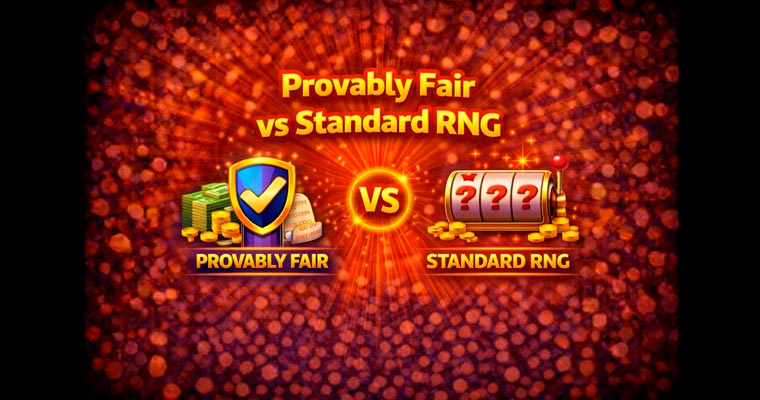
Every online slot needs a way to prove its outcomes are fair. The traditional method is a certified Random Number Generator (RNG), tested by independent labs. The newer method, common in crypto casinos, is Provably Fair — a cryptographic system that lets you verify each outcome yourself. Both aim to prove fairness, but they work differently, prove different things, and have different limitations. Here’s what each actually does — and what neither can do.
Standard RNG: A “black box” system. Outcomes are generated by a certified algorithm. You trust the casino’s license, the software provider, and the independent testing lab (GLI, BMM, eCOGRA, iTech Labs) that audited it. You cannot verify individual results yourself.
Provably Fair: A “transparent box” system. Outcomes are determined by a combination of a server seed (from the casino) and a client seed (from your browser). After each round, you can cryptographically verify that the result wasn’t changed after you placed your bet. You verify individual results yourself.
Neither changes the house edge. Both systems produce outcomes where the casino has a mathematical advantage. Fairness means the game isn’t rigged beyond its published rules — not that you’ll win.
How Standard RNG Works
The vast majority of online slots — from providers like Pragmatic Play, NetEnt, Play’n Go, and Push Gaming — use standard RNG systems. Here’s the trust chain:
1. The provider builds the game with a pseudorandom number generator (PRNG) that produces statistically unpredictable outcomes. Modern certified systems often combine PRNG with a True Random Number Generator (TRNG) — using physical phenomena like server noise or atmospheric entropy to create an unpredictable starting seed. Each spin generates a number mapped to a game outcome according to the game’s math model.
2. An independent testing lab — such as GLI, BMM, eCOGRA, or iTech Labs — audits the RNG. They run millions of simulated spins to verify that outcomes are statistically random, match the published RTP, and meet standards like GLI-11.
3. A regulatory authority — such as the MGA (Malta), UKGC (UK), or a state gaming commission — issues a license certifying that the casino operates with audited, compliant games.
4. You play. You see the result. You cannot independently verify the underlying math. You trust the chain: provider → lab → regulator → casino.
What Standard RNG Proves
When the system works as intended: the RNG produces independent outcomes that match the game’s published math model over millions of spins. Testing labs verify this statistically. Regulators enforce compliance. This is the system that underpins virtually all licensed online gambling worldwide.
What Standard RNG Cannot Prove
You cannot verify any individual spin. You cannot directly confirm that the exact RNG code tested by the lab is the code running live on the server — though in regulated environments, deployment controls, version approvals, and ongoing compliance checks are specifically designed to address this. You cannot see the seed, the algorithm, or the mapping logic. Your trust rests on institutions — the lab’s competence, the regulator’s enforcement, and the casino’s compliance. For well-regulated markets (UKGC, MGA, major state commissions), this system has a strong track record. For offshore or weakly regulated casinos, the trust chain is only as strong as its weakest link.
How Provably Fair Works
Provably Fair emerged from the crypto casino ecosystem, where players wanted mathematical proof of fairness rather than institutional trust. The system uses cryptographic hashing to let you verify each individual outcome.
1. Before the round: The casino generates a server seed and shows you a cryptographic hash of it (the hash hides the actual seed). You can also provide your own client seed. A nonce (counter) increments with each bet.
2. The round plays: The outcome is determined by combining the server seed, your client seed, and the nonce through a hash-based algorithm (often SHA-256, though implementations vary). This combination produces the result.
3. After the round: The casino reveals the unhashed server seed. You can now run the same hash function yourself — combining the revealed server seed + your client seed + the nonce — and verify that the result matches what was displayed. If it matches, the outcome wasn’t changed after you bet.
4. Seed rotation: After revealing a server seed, the casino generates a new one for future bets. You can change your client seed at any time.
The system’s cryptographic protection depends on the casino not knowing your client seed in advance. If you leave the default client seed unchanged for hundreds of bets, you reduce the independent randomness you contribute. Actively changing your client seed periodically strengthens the verification — though in practice, most players never do this. It’s a best practice for players who actually intend to verify outcomes.
What Provably Fair Proves
That the outcome was determined before you placed your bet and wasn’t changed afterward. The cryptographic hash commitment makes post-bet manipulation mathematically detectable. This is genuine, verifiable proof of non-tampering for each individual round.
What Provably Fair Cannot Prove
Provably Fair does not prove that the house edge is what the casino claims. It proves non-tampering, not fairness of odds. A casino could implement a provably fair system with a 20% house edge — every outcome would be verifiable and non-tampered, but the game would still be heavily unfavorable. To verify the actual house edge, you’d need to analyze thousands of outcomes statistically — which is exactly what testing labs do for standard RNG games.
Additionally, Provably Fair is much easier to implement for simple games (dice, crash, coin flip, Plinko) where outcomes map directly to a single number. For complex video slots with multiple reels, bonus features, and cascading mechanics, full Provably Fair verification is technically challenging. Most “provably fair slots” at crypto casinos are in-house “Originals” with simpler structures — not the same multi-feature experiences you get from major traditional providers. However, the industry is evolving: some licensed providers like BGaming have integrated Provably Fair verification into multi-reel video slots, suggesting the gap may narrow over time.
Standard RNG vs Provably Fair: Side by Side
Trust model: Institutional — labs, regulators, licenses.
Verification: You cannot verify individual outcomes.
Game variety: Full range — complex slots, table games, live dealer.
Providers: Pragmatic Play, NetEnt, Play’n Go, Microgaming, etc.
Regulation: Required for licensed markets (UK, Malta, EU, US states).
Best for: Players comfortable with regulated markets who want the widest game selection.
Trust model: Cryptographic — player-verifiable proof per round.
Verification: You can verify each individual outcome.
Game variety: Mostly simpler games — dice, crash, mines, basic slots.
Providers: Casino in-house “Originals” (Stake, BC.Game, Roobet, etc.).
Regulation: Often found at crypto casinos with lighter licensing (Curaçao, etc.).
Best for: Players who prioritize verifiable transparency over game variety.
What Neither System Can Do
“Provably fair means better odds.” No. The house edge is a separate design choice. A provably fair game can have a 1% house edge or a 15% house edge — the verification system doesn’t constrain it. Some crypto casino originals do offer lower house edges than typical slots, but that’s a business decision, not a consequence of Provably Fair technology.
“Standard RNG means the casino can rig individual spins.” At properly licensed casinos, no. The RNG code is audited before deployment, and regulators conduct ongoing compliance checks. Could a completely unregulated, unlicensed casino tamper with its RNG? Theoretically yes — which is why licensing matters. See our article on whether casinos rig slots.
“Provably Fair = blockchain.” Not exactly. Provably Fair uses cryptographic hashing, which is a building block of blockchain technology, but a game can be provably fair without using a blockchain. Some crypto casinos do record outcomes on-chain for additional immutability, but this isn’t required for the core verification to work.
“I should only play provably fair games.” That depends on your priorities. If you want to play Gates of Olympus, Sweet Bonanza, or any game from a major provider, you’ll be playing with standard RNG — and at a properly licensed casino, the institutional trust chain is well-established and has decades of track record. Provably Fair offers a different trust model, not a universally superior one.
Where Each System Lives in Practice
| Feature | Standard RNG | Provably Fair |
|---|---|---|
| Typical platform | Licensed online casinos (UKGC, MGA, state-regulated) | Crypto casinos (Curaçao license, some unlicensed) |
| Game types | Complex slots, table games, live dealer, jackpots | Dice, crash, mines, Plinko, simple slots, some table games |
| Software providers | Pragmatic Play, NetEnt, Play’n Go, BTG, Hacksaw, Nolimit City, etc. | Casino in-house (“Originals”), some third-party PF providers |
| RTP disclosure | Published in-game, verified by testing labs | Varies — some publish, some don’t. Player must analyze or trust the claim |
| Individual outcome verification | No | Yes (via hash + seed comparison) |
| Regulatory oversight | Strong (major jurisdictions) | Varies (Curaçao = weaker enforcement; some platforms unlicensed) |
| Player skill required | None — trust the system | Some — need to understand seeds/hashes to verify |
Which Should You Trust?
This is the wrong question — or rather, it’s incomplete. Both systems have strengths and weaknesses, and the real question is: what specifically are you trusting, and what are you verifying?
If you play at a well-regulated casino (UKGC, MGA, US state license) with games from major providers, standard RNG has a strong, decades-long track record. The trust chain — provider → lab → regulator — provides institutional assurance. You can’t verify individual spins, but the system is designed so you don’t need to.
If you play at a crypto casino and want to verify outcomes, Provably Fair gives you that tool. But verify more than just individual outcomes — check the platform’s licensing, withdrawal track record, player reviews, and whether the RTP claims are supported by published math or just marketing.
If you play at an unlicensed casino with neither strong regulation nor Provably Fair verification — that’s where the real risk is. Neither trust model protects you if the operator is dishonest and unaccountable.
How to Evaluate a Provably Fair Platform
1. Can you view and change your client seed? If yes, the PF implementation is genuine. If not, it may be cosmetic.
2. Is the RTP / house edge explicitly published? PF proves non-tampering, not fair odds. If the casino doesn’t disclose the house edge, you can’t evaluate the game.
3. Is the algorithm documented? Reputable PF platforms publish their hash logic, seed generation method, and outcome mapping so players (or third parties) can audit independently.
4. Is there a seed history / verification tool? Good platforms let you review past server seeds and verify previous outcomes retroactively.
5. Are withdrawals and limits transparent? PF proves game fairness — it says nothing about whether the casino will actually pay you. Check withdrawal policies, processing times, and player reviews separately.
6. Is the operator licensed and accountable? Even a perfectly provably fair game on an unlicensed platform carries platform risk (frozen funds, arbitrary account closures).
Does Any of This Matter for Choosing a Slot?
For most players picking games through SlotRandomizer: probably not. The games in our database come from licensed providers whose RNG is certified by independent labs. When you pick a game and check its RTP and volatility, those numbers are backed by the standard RNG certification process.
If you’re playing at a crypto casino with Provably Fair originals, the same principles apply — check the house edge, understand the volatility, and set your limits. The trust model is different, but the math of gambling is the same: the house has an edge, and no verification system changes that.
For a deeper look at how RNG, rigging claims, and AI prediction scams relate, see our articles on whether casinos rig slots, whether AI can predict outcomes, and our review of slot prediction systems.
Every game in the randomizer comes from a licensed provider with certified RNG. Check the RTP, volatility, and max win before you spin — regardless of which trust model you prefer.
Frequently Asked Questions
The Bottom Line
Standard RNG and Provably Fair are two different trust models — not two different levels of fairness. Standard RNG asks you to trust institutions (labs, regulators, providers). Provably Fair gives you cryptographic tools to verify individual outcomes. Both have the house edge built in. Neither guarantees you’ll win.
For most players, the practical question isn’t “which system is fairer?” — it’s “is this casino licensed, are the games from reputable providers, and have I checked the RTP?” Those questions matter more than the underlying verification technology. Play where you’re comfortable, verify what you can, and always remember: the math doesn’t change regardless of how it’s proven.