If you’ve ever played an online slot — or stood in front of one in a casino — you’ve probably asked yourself: are slot machines actually random? Here’s the complete answer, including how RNG technology works, what the casino can and can’t control, and what it all means for your odds.
Short answer: Yes. Every licensed slot machine uses a Random Number Generator (RNG) to determine each spin’s outcome. The result is decided the instant you press the button. Nothing that happened before — no streak, no time of day — has any influence on what comes next.
But “random” doesn’t mean what most people think it means. It doesn’t mean every session is a coin flip. It doesn’t mean you have a 50/50 chance of winning. And it definitely doesn’t mean the casino can’t profit.
This article breaks down exactly how slot randomness works, what the RNG does behind the scenes, and what it means for you as a player.
What Is a Random Number Generator (RNG)?
A Random Number Generator is a small piece of software embedded in every slot machine. Its only job is to produce numbers — continuously, thousands of times per second, whether anyone is playing the machine or not.
When you hit the spin button, the RNG captures the number it generated at that exact millisecond. That number gets mapped to a specific combination of symbols on the reels. The mapping determines whether you win or lose, how much you win, and which symbols you see on screen.
The RNG doesn’t “know” your bet size, your balance, how long you’ve been playing, or whether the last 50 spins were losses. It simply generates numbers. Everything else — the visual animation, the spinning reels, the near-miss effects — is just a presentation layer.
How Does the RNG Actually Work?
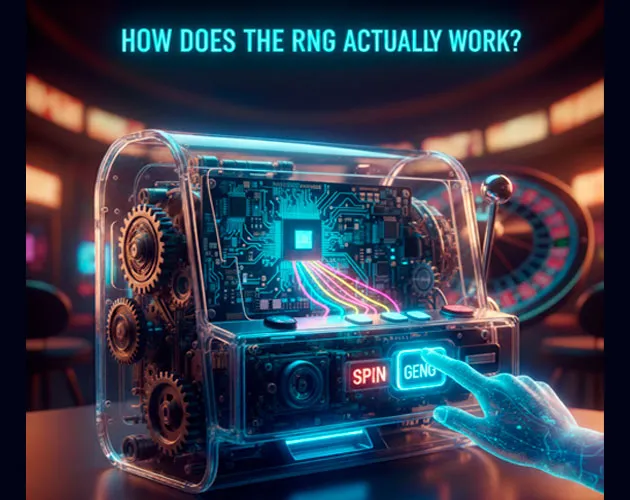
Most slot machines use what’s called a Pseudo-Random Number Generator (PRNG). Despite the name suggesting it’s not truly random, a well-implemented PRNG produces results that are statistically indistinguishable from true randomness.
Here’s the simplified process:
The PRNG starts with a seed value — often derived from a high-precision timestamp or other unpredictable input. It runs that seed through a mathematical algorithm (common ones include the Mersenne Twister and Linear Congruential Generator) to produce a sequence of numbers. Each number in the sequence appears completely unrelated to the previous one.
When you press spin, the system grabs the current PRNG output and translates it into reel positions. Each reel has a strip of symbols defined by the game designer. The random number selects a stop position on each strip, and the combination of those positions determines the outcome.
This entire process happens in less than a millisecond. The reels spinning on your screen are purely cosmetic — the outcome was already decided before the animation even starts.
Are Slot Machines Truly Random or Programmed?
This is the most common question players ask, and the answer is: both, depending on what you mean.
The outcome of each individual spin is random. No person, no algorithm, and no casino manager decides whether your next spin is a win or a loss. The RNG handles that, and it cannot be overridden during gameplay.
But the overall mathematics of the game are programmed. Before a slot ever reaches a casino floor or an online lobby, its designer defines fixed parameters: the symbol distribution on each reel strip, the paytable (which combinations pay how much), the Return to Player percentage (RTP), and the volatility profile.
These parameters determine the long-term behavior of the machine. Over millions of spins, the slot will return approximately its stated RTP — say, 96% — meaning that for every $100 wagered across all players, about $96 gets paid back and $4 goes to the casino.
Think of it like rolling dice in a board game: each roll is random, but the rules of the game determine what those rolls mean and who has the statistical edge.
Can a Casino Control Whether You Win or Lose?
No — not on a spin-by-spin basis. Once a slot game is certified and deployed, the casino cannot reach in and flip the outcome of your next spin.
However, a casino can choose which games to offer. Different games have different RTPs. A casino might stock its floor with slots that return 92% instead of 96%. The randomness is identical in both cases — but the house edge is double.
Online casinos sometimes offer multiple RTP versions of the same game. Pragmatic Play, for example, releases many of its slots with RTP options like 96.5%, 95.5%, and 94.5%. The casino operator selects which version to run. The player usually doesn’t know which version they’re playing unless the information is disclosed in the game’s help menu.
The randomness is real, but the odds are set before you ever press spin.
What About Hot and Cold Machines?

There’s a persistent belief that slot machines run in cycles — that a machine that hasn’t paid out in a while is “due” for a big win, or that one that just hit a jackpot will go cold.
This is a misconception. Because each spin is generated independently by the RNG, the machine has no memory of previous results. A slot that just paid a 5,000x jackpot has the exact same probability of hitting another jackpot on the very next spin as a machine that hasn’t paid out in three hours.
The human brain is exceptionally good at finding patterns, even where none exist. A run of 20 losing spins feels like the machine is “cold,” but statistically it’s completely normal — especially on high-volatility slots where long dry spells are part of the mathematical design.
How Is Slot Randomness Regulated and Tested?
Slot RNG systems are heavily regulated. Before any game goes live — whether in a physical casino or online — it must be tested and certified by an independent testing laboratory.
The major testing bodies include Gaming Laboratories International (GLI), iTech Labs, eCOGRA, BMM Testlabs, and NMi. These organizations run millions of simulated spins through the game, verify that the RNG produces statistically random results, confirm that the actual RTP matches the stated RTP, and check that no external manipulation is possible.
Licensed jurisdictions — such as the UK Gambling Commission, the Malta Gaming Authority, Curaçao, and various US state gaming boards — require this testing as a condition of the operator’s license. Running a slot with a tampered RNG is a criminal offense in most jurisdictions.
For players, the practical takeaway is straightforward: if you’re playing at a licensed casino with games from recognized providers (Pragmatic Play, NetEnt, Play’n Go, etc.), the randomness is genuine. If you’re playing at an unlicensed site, you have no such guarantee.
What Is RTP and How Does It Relate to Randomness?
RTP stands for Return to Player. It’s expressed as a percentage — for example, 96.50% — and represents the theoretical amount a slot pays back over an extremely large number of spins.
RTP and randomness are related but different concepts. The RNG creates the randomness of each individual spin. RTP describes the statistical average of all those random outcomes over time.
A 96.50% RTP doesn’t mean you’ll get $96.50 back for every $100 you bet. In a single session, you might win 500% of your starting balance or lose everything. RTP only converges toward its stated value over millions of spins — a phenomenon known as the law of large numbers.
— Very low house edge, considered generous
— Industry average
— Higher house edge, common in popular titles
— Significant house edge, generally unfavorable
What Is Volatility and Why Does It Matter?
Volatility (sometimes called variance) describes how a slot distributes its payouts over time. Two slots can have the exact same RTP but feel completely different to play because of volatility.
Low-volatility slots pay out small amounts frequently. You’ll see lots of small wins that keep your balance relatively stable. Lower risk, but also lower maximum payouts.
High-volatility slots pay out larger amounts but much less frequently. Long losing streaks punctuated by big wins. Higher risk — and where the massive 10,000x or 50,000x payouts happen.
This is entirely by design and fully compatible with randomness. The RNG still generates random results on every spin — but the paytable and symbol distribution are structured so that big-paying combinations are rare.
When you use a tool like SlotRandomizer, each result card shows the volatility level with color coding — green for Low, orange for Medium, red for High — so you can gauge the risk profile instantly.
Common Myths About Slot Machine Randomness
How to Use Randomness to Your Advantage
You can’t beat the RNG — and anyone who claims otherwise is either misinformed or trying to sell you something. But understanding how randomness works can help you make better decisions.
Choose games with higher RTP. The randomness is the same regardless of RTP, but your expected loss per bet is lower on a 97% slot than a 94% slot.
Match volatility to your bankroll. If you have a small budget, high-volatility slots will likely drain it before the big wins arrive. Low-volatility games give you more spins for your money.
Don’t chase losses. The RNG doesn’t care that you’re down $200. Your next spin has the same odds as your first one. If you’re losing more than you planned to spend, stop playing.
Looking for something new to play? Our random slot generator picks from 3,300+ games across 13 top providers — discover a title you’d never find scrolling through a casino lobby.
Frequently Asked Questions
The Bottom Line
Are slot machines random? Yes — genuinely, mathematically, verifiably random. Every spin on a licensed slot is determined by a Random Number Generator that operates independently of everything else: your bet history, the time of day, the casino’s profit targets, and every other spin that has ever occurred on that machine.
But random doesn’t mean fair in the way most people use that word. The house always has a mathematical edge, built into the game through RTP and symbol distribution. Randomness ensures that you can’t predict outcomes, not that outcomes are evenly split between wins and losses.
Understanding this distinction is the most important thing a slot player can know. The RNG is real. The randomness is real. And the house edge is also real.
Play games you enjoy, set limits you can afford, and if you need help picking your next slot — try SlotRandomizer.